

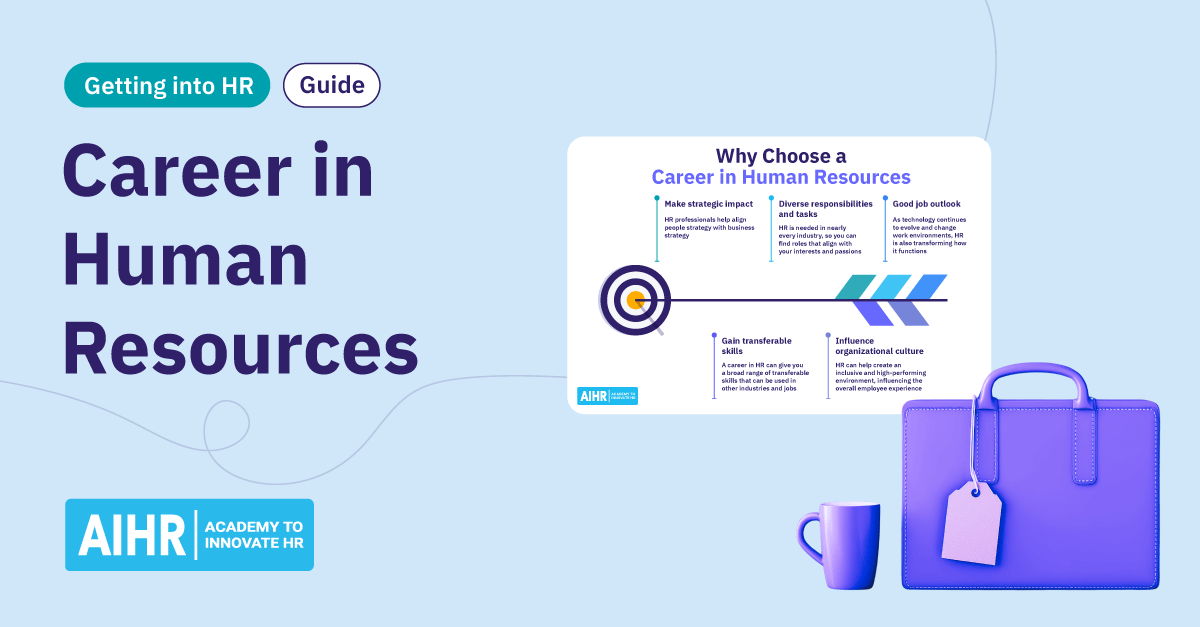
A career in Human Resources is no longer one path with a few predictable stops. HR is becoming more specialized, and the roles growing fastest are those helping organizations make better decisions, scale with technology, reduce risk, and stay competitive in tough talent markets.
That’s why this isn’t a generic HR job list. Using Revelio Labs opportunity signals (powering AIHR’s HR Career Map), we’ve identified the hottest and most in-demand HR roles right now—so you can see where the market is moving, what each role actually does, and which skills to build to move into it.
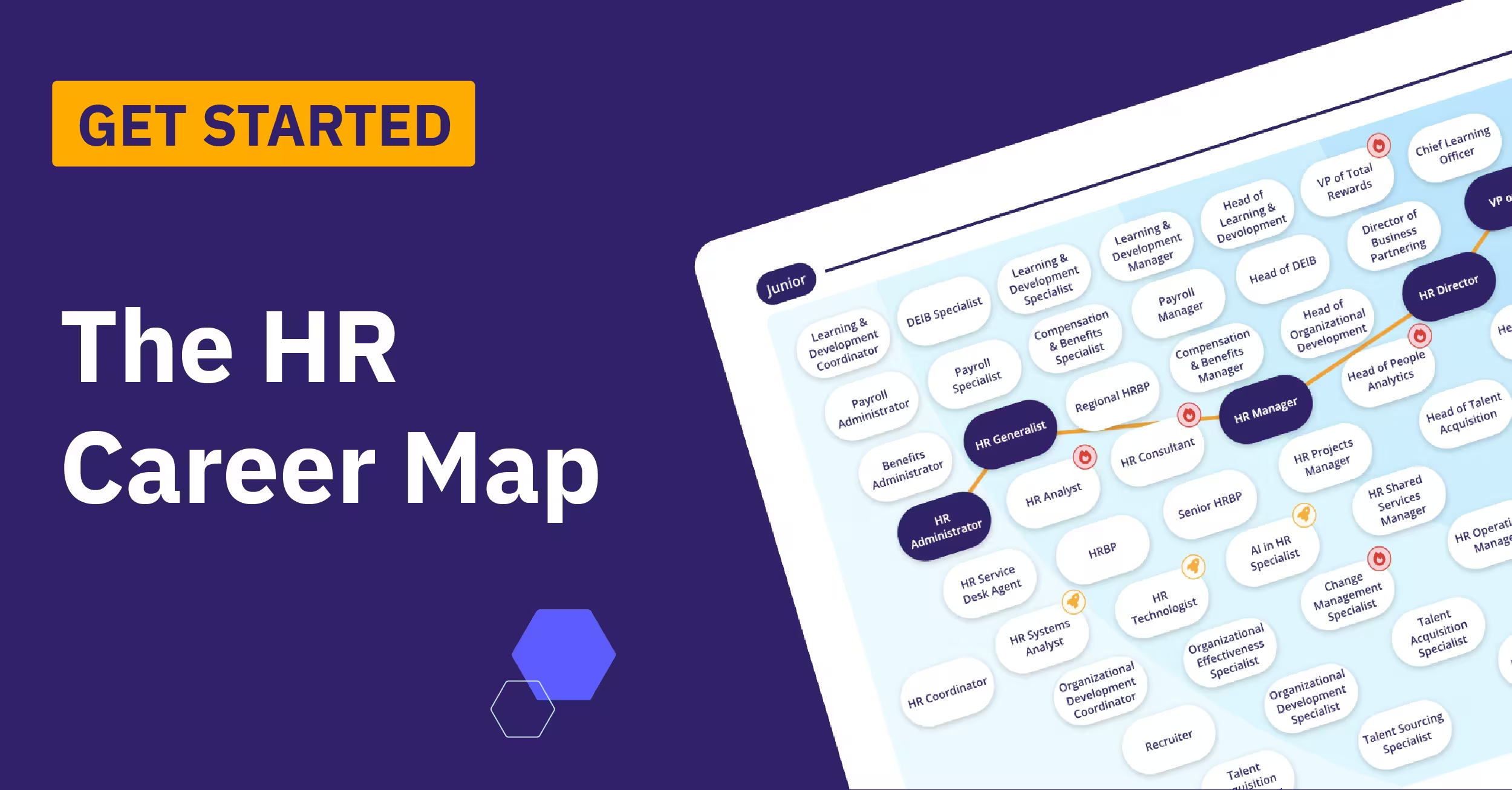
Ready to plan your next step? Start by exploring the AIHR HR Career Map to compare roles, transitions, and skill requirements.
Contents
What makes a “hot” career in Human Resources?
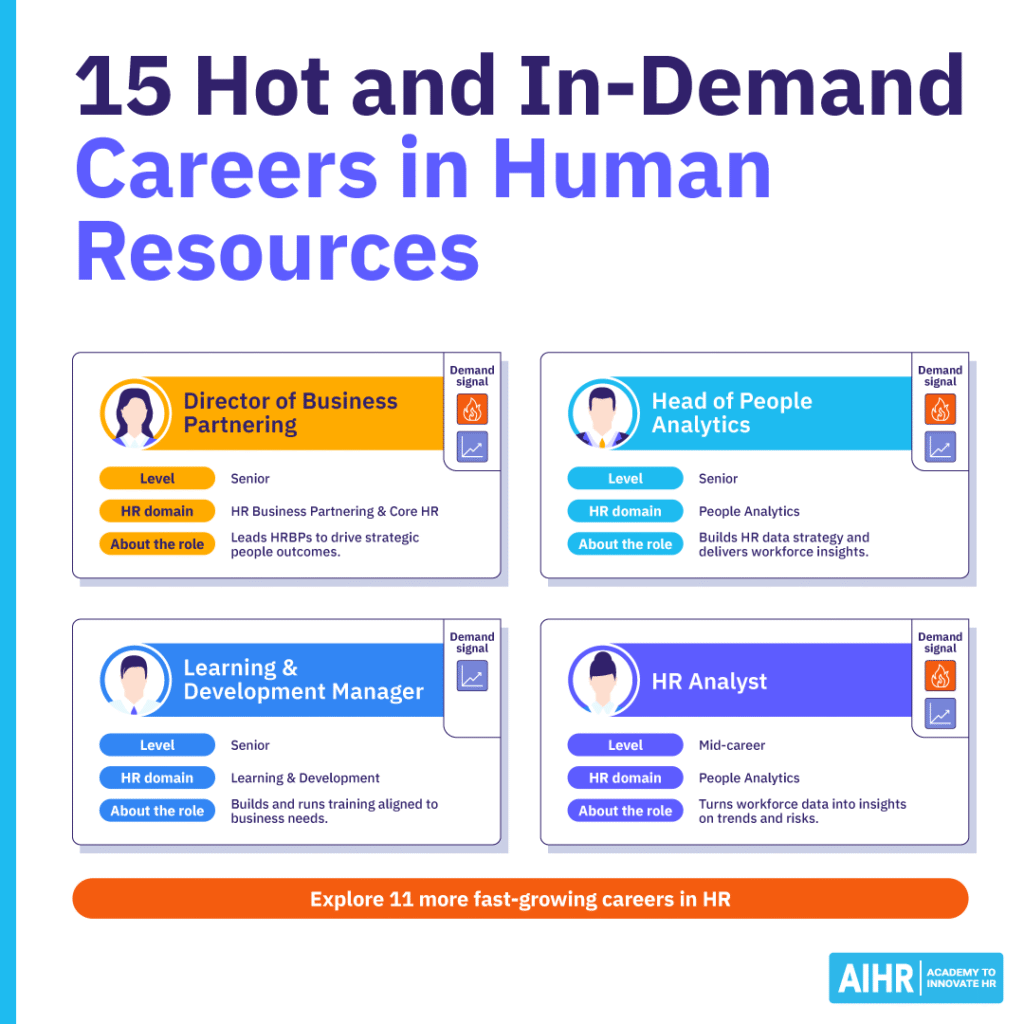
15 hot and in-demand careers in HR
How to choose the right HR career path
FAQ
Key takeaways
- Revelio Labs data flags 8 hot jobs and 15 in-demand HR roles. This list focuses on the top 15 that best represent the areas with the strongest demand.
- The hottest clusters right now sit in People Analytics, Digital HR, Total Rewards, Employee Relations, and strategic HR Business Partnering.
- Each role below includes a practical “what to build next” to help you move from interest to action.
- Use the AIHR HR Career Map to compare roles, see transitions, and turn your goal into a skill plan.
What makes a “hot” career in Human Resources?
Not all HR roles grow at the same pace. Some spike because of regulation, technology, global talent shifts, or a sudden need for better workforce decisions.
In this article, we use Revelio Labs signals shown in the HR Career Map:
- 🔥Hot job: A role showing strong momentum and opportunity right now.
- 📈 In-demand job: A role with consistently strong opportunities.
There has never been a better time to build your career in HR. With renewed focus and HR becoming more strategically important to business success, HR professionals have an opportunity to reposition and reframe their careers in a meaningful way.

15 hot and in-demand careers in HR
Quick view of the 15 roles
| Role | Demand signal | Level | HR domain | About the role |
| Director of Business Partnering | 🔥📈 | Senior | HR Business Partnering & Core HR | Leads HRBPs driving strategic people outcomes |
| Global Mobility Specialist | 🔥📈 | Senior | Compensation & Benefits | Manages relocations, immigration, and global benefits coordination |
| Head of Digital HR | 🔥📈 | Senior | Digital HR | Leads HR tech, automation, and digital employee platforms |
| Head of People Analytics | 🔥📈 | Senior | People Analytics | Builds HR data strategy and delivers workforce insights |
| HR Analyst | 🔥📈 | Mid-career | People Analytics | Turns workforce data into insights on trends and risks |
| HR Consultant | 🔥📈 | Mid-career | HR Business Partnering & Core HR | Advises teams on policy, change, and compliance |
| Organizational Effectiveness Specialist | 🔥📈 | Mid-career | Organizational Development | Improves team design, operating models, and leadership capability |
| VP of Total Rewards | 🔥 | Executive | Compensation & Benefits | Owns rewards strategy across comp, benefits, recognition, and mobility |
| Employee Relations Specialist | 📈 | Mid-career | Employee Relations | Manages grievances, investigations, and conflict resolution |
| Head of Employee Relations | 📈 | Senior | Employee Relations | Leads ER strategy, labor relations, and workplace policy |
| HR Systems Analyst | 📈 | Mid-career | Digital HR | Configures and reports on HR systems to streamline operations |
| HR Technologist | 📈 | Mid-career | Digital HR | Owns HR tools/platform rollouts and system effectiveness |
| Learning & Development Manager | 📈 | Senior | Learning & Development | Builds and runs training aligned to business needs |
| Organizational Development Coordinator | 📈 | Entry level | Organizational Development | Coordinates OD programs, logistics, and communication |
| Payroll Manager | 📈 | Senior | Compensation & Benefits | Ensures payroll accuracy and compliance |
The HR job market is rewarding professionals who can drive business outcomes, use data confidently, and modernize how HR works. Based on Revelio Labs opportunity signals, these are the roles showing the strongest momentum right now, starting with the “hot jobs,” then the broader set of in-demand roles.
1. Director of Business Partnering 🔥📈
Director of Business Partnering is a high-impact step if you’re drawn to business-facing work and want to influence outcomes beyond “HR support,”.
In this role, you’ll lead HRBPs who work directly with leaders to embed people strategy into operational plans and deliver measurable talent outcomes across the business. This HR career is rising because companies want HR to drive performance, capability, and retention in a way that’s tightly linked to business priorities, especially as change becomes constant and leadership teams expect clearer ROI on people initiatives.
Skills to build
- Strategic workforce planning
- Stakeholder influence and executive communication
- Business acumen (operating metrics, OKRs)
- Data literacy (turnover, skills, capacity)
- Coaching and leadership for HRBPs
2. Global Mobility Specialist 🔥📈
Global Mobility is a strong fit if you like complex coordination, global work, and policies that have real consequences. You support expatriate employees through relocation, immigration, and international benefits, often coordinating between employees, vendors, payroll, and rewards.
Demand is increasing because hiring and internal transfers are becoming more global, compliance complexity continues to rise across regions, and organizations need structured mobility support to move critical skills quickly while protecting employee experience and reducing risk.
Skills to build
- Mobility policy administration and case management
- Vendor management and service-level oversight
- Immigration process knowledge and documentation discipline
- International benefits coordination and payroll interfaces
- Employee experience design for relocations
3. Head of Digital HR 🔥📈
Head of Digital HR is one of the clearest “future HR” leadership roles. You oversee HR technology, automation, and digital employee platforms, streamlining operations, improving user experience, and enabling more reliable decision-making through cleaner data.
This role is in demand because HR teams are under pressure to deliver more with less, HR tech stacks are expanding quickly, and organizations need leaders who can turn tools into adoption, efficiency, and measurable outcomes rather than a collection of underused systems.
Skills to build
- HR tech strategy (architecture, roadmap, stack decisions)
- Process redesign and automation thinking
- Data governance and privacy fundamentals
- Vendor selection and implementation leadership
- Change management and adoption enablement
4. Head of People Analytics 🔥📈
If you want to shape strategy using evidence, the Head of People Analytics is where HR becomes measurable and predictive. You define what to measure, build governance and capability, and translate HR data into insights that leaders act on.
Demand is rising because organizations are expected to make workforce decisions with evidence, not intuition, especially around attrition risk, skills planning, and productivity. Additionally, AI and advanced tooling add value only when data quality, measurement, and interpretation are strong.
Skills to build
- Measurement design and KPI governance
- Analytics strategy and operating model design
- Stakeholder consulting (turn questions into analysis)
- Data storytelling for executives
- Scalable reporting and insight pipelines
5. HR Analyst 🔥📈
HR Analyst roles are growing because organizations need clarity on workforce trends—and someone who can turn data into decisions. You analyze people data related to headcount, attrition, and DEIB to surface patterns and risks that influence planning.
This role is in demand because companies have more HR data than ever, but struggle to connect it into usable insights, leaders want early warning indicators rather than lagging reports, and HR teams need impact without continually increasing headcount.
Skills to build
- Metrics, dashboards, and visualization (Power BI/Tableau)
- Data definitions and quality checks
- Basic querying concepts (e.g., SQL fundamentals)
- Insight storytelling and recommendations
- Practical experimentation and evaluation
Career movement isn’t about waiting for the next role to appear; it’s about building the skills that make multiple roles possible. Every upskilling opportunity expands your options, especially when you consciously develop, document, and use those skills in practice.

6. HR Consultant 🔥📈
HR Consultant is a strong path if you like diagnosing problems, advising leaders, and supporting change. You guide teams on HR policy, organizational change, and compliance, often bringing structure and options to complex situations.
This role is increasingly in demand because organizations are constantly redesigning work, leaders want fast, pragmatic HR guidance, and employee expectations and regulatory considerations make people decisions more complex and risk-sensitive.
Skills to build
- Consulting toolkit (problem framing, hypothesis thinking)
- Stakeholder mapping and alignment
- Change management planning and communications
- Policy design and risk-aware decision making
- Facilitation and project delivery
7. Organizational Effectiveness Specialist 🔥📈
Organizational Effectiveness is a fast-growing niche if you enjoy improving how teams work, not just what they work on. You enhance team design, leadership effectiveness, and operating models to make the organization clearer, faster, and more resilient. This role is rising because companies want agility but often lack role clarity and decision rights, operating model friction slows execution and increases burnout, and leadership capability must scale as structures and strategies change.
Skills to build
- Operating model mapping (roles, decisions, handoffs)
- Diagnostic methods (interviews, surveys, listening data)
- Facilitation and alignment techniques
- Leadership enablement and capability building
- Change execution and measurement
8. VP of Total Rewards 🔥
VP of Total Rewards is a high-impact executive role for leaders who can balance competitiveness, fairness, and governance. You shape enterprise-level compensation, benefits, recognition, and often mobility strategy, ensuring global consistency, cost sustainability, and talent attraction.
Demand is strong because rewards are now a primary lever for attraction and retention, pay transparency and equity expectations are rising, and global workforces require more consistent governance across regions.
Skills to build
- Rewards strategy and program governance
- Job architecture, leveling, and pay structures
- Pay equity analysis and compensation analytics
- Executive influence and board-ready storytelling
- Global program design and compliance awareness
9. Employee Relations Specialist 📈
Employee Relations is the backbone of a fair, consistent workplace—and demand grows as workplace expectations and risks increase. You handle grievances, investigations, and conflict resolution with discretion, helping protect both employees and the organization.
This role remains in demand because disputes are more visible and higher-stakes, organizations need consistency in how issues are handled, and managers often need support navigating sensitive situations correctly.
Skills to build
- Investigation planning and interviewing
- Documentation and case management
- Conflict resolution and mediation basics
- Policy interpretation and consistency checks
- Stakeholder management (legal, HR, leadership)
10. Head of Employee Relations 📈
The Head of Employee Relations is a leadership role focused on building standards, capability, and consistency at scale. You oversee conflict resolution, workplace policies, and labor relations (where relevant), while improving how managers handle issues before they escalate.
Demand is high because inconsistent ER handling creates legal and reputational risk, case volumes can rise quickly during change, and organizations increasingly need prevention-focused ER strategies rooted in training, policy governance, and trend analysis.
Skills to build
- ER operating model design and escalation frameworks
- Manager enablement and coaching systems
- Policy governance and consistency management
- Case trend analysis and root-cause prevention
- Partnership with legal and senior leadership
11. HR Systems Analyst 📈
HR Systems Analysts are in demand because better HR decisions start with better HR data and system discipline. You support configuration, implementation, and reporting for HR systems, helping streamline operations and improve data reliability.
Demand stays strong because organizations need trustworthy reporting, systems sprawl creates governance and integration challenges, and many process improvements only stick when the system is designed to support them.
Skills to build
- Requirements gathering and process mapping
- HRIS configuration and workflow understanding
- Reporting, data validation, and documentation
- System governance and change control
- Cross-functional communication (HR, IT, vendors)
12. HR Technologist 📈
HR Technologists help HR stacks deliver real value—adoption, efficiency, and measurable outcomes. You manage HR tools and implementations, ensuring platforms are user-friendly and aligned to how work actually happens. This role is in demand because HR tech portfolios keep expanding, low adoption wastes budget and frustrates employees, and HR needs people who can translate real user needs into systems that enable better experiences and stronger decisions.
Skills to build
- Vendor management and implementation planning
- Product mindset (users, workflows, adoption)
- Change management and enablement
- Data flow and integration concepts
- Governance and continuous improvement
Typical next steps: HR Tech Lead, Head of Digital HR, People Ops leadership
13. Learning & Development Manager 📈
Learning & Development Managers are in demand because reskilling is now a business necessity, not a perk. You build and deliver training programs aligned with business needs and measure whether learning actually changes performance. Demand remains strong because skills evolve quickly (especially with AI), organizations prefer internal mobility over constant hiring, and leadership teams increasingly expect proof of learning impact rather than participation metrics.
Skills to build
- Needs analysis and performance consulting
- Learning design and delivery strategy
- Program management and stakeholder alignment
- Learning measurement and evaluation
- Manager enablement and facilitation
14. Organizational Development Coordinator 📈
The OD Coordinator role is a strong entry point if you like enabling change programs and keeping complex initiatives moving. You support OD delivery through communications, logistics, and coordination, often gaining exposure to leadership development, org design, and culture work.
This role is in demand because OD programs are expanding, change efforts fail without communication and follow-through, and teams need reliable coordination to keep multiple initiatives on track.
Skills to build
- Program coordination and project hygiene
- Stakeholder communication and alignment
- Workshop and facilitation logistics
- Basic data handling (surveys, tracking, reporting)
- Operational discipline and follow-through
15. Payroll Manager 📈
Payroll Managers remain consistently in demand because payroll errors immediately damage trust, and compliance complexity continues to rise. You oversee payroll processing and ensure accurate, compliant pay practices that comply with tax and labor laws.
Demand is strong because multi-state and multi-country payroll increases complexity, audit and governance expectations are rising, and organizations want tighter controls to prevent costly mistakes and employee dissatisfaction.
Skills to build
- Payroll governance and control frameworks
- Compliance coordination and risk management
- Process improvement and standardization
- Vendor oversight and stakeholder alignment
- Reporting and root-cause analysis
How to choose the right HR career path
The fastest way to move forward is to stop thinking in terms of job titles and start thinking in terms of tracks.
Step 1: Pick 1 track for the next 12 months
Choose the track that fits your strengths and interests:
- People Analytics (HR Analyst, Head of People Analytics): Best if you like data, problem-solving, and turning questions into metrics.
- Digital HR (HR Systems Analyst, HR Technologist, Head of Digital HR): Best if you like systems, automation, and improving workflows.
- Total Rewards (Payroll Manager, Global Mobility Specialist, VP of Total Rewards): Best if you like structure, governance, and balancing fairness with business needs.
- Org Effectiveness & ER (Organizational Effectiveness Specialist, Employee Relations roles): Best if you like diagnosing organizational friction and enabling leaders.
Step 2: Use the AIHR HR Career Map to build your route
Open the Career Map and do this in 10 minutes:
- Find your current role
- Click your target role
- Review the skills you need and typical transitions
- Pick 2 skills to build next (not 10).
Step 3: Choose a learning plan
Now that you’ve picked your track and two skills to build next, turn that into a learning plan you can stick to.
For example,
- Choose a Certificate Program if you want a structured path for a specific track. This is best if you’re changing direction or aiming for a bigger move.
- Choose Full Academy Access if you want flexibility to build multiple skills across tracks. This is best if you’re exploring or upskilling for a broader role and want to stay ahead with the latest developments.
Write your plan in one line: “Over the next 8–12 weeks, I’ll complete [Certificate Program] and produce a proof of skill output.”
Step 4: Build proof of skill
Pick one output that shows you can do the work, for example:
- Build a simple attrition dashboard and present 3 actions it suggests
- Standardize HRIS fields (job title, level, location) and document your data rules
- Draft a global mobility checklist for relocations and vendor handoffs
- Create a pay band proposal and a basic pay equity review approach
- Write an ER case triage playbook (what to do, who owns what, timelines).
Ready to plan your next step?
If you’re serious about building a career in Human Resources, don’t stop at “interesting roles.” Turn your interest into a plan. Explore roles and transitions in the AIHR HR Career Map (it’s free). You can also use the HR Career Hub to find learning resources and career guidance. Choose one focused learning path and build proof that you can do the job.
FAQ
Yes—especially if you choose a path with clear skills and outcomes. HR now includes specialist careers in data, digital transformation, rewards, employee relations, and organizational effectiveness. If you want stability and progression, pick a track, map your next 2 roles, and build job-relevant proof of skill using the AIHR HR Career Map.
In many organizations, the highest-paid roles are senior leadership positions (like CHRO) and executive specialist roles (like VP of Total Rewards), but pay varies by company size, industry, and location. Use the AIHR HR Career Map to compare roles and see typical ranges and demand signals side by side.
They can. Entry roles often start lower, but pay increases quickly when you build scarce, high-impact skills—especially in People Analytics, Digital HR, and Total Rewards leadership. The fastest way to improve earnings is to specialize, build measurable outcomes, and move into roles with higher business ownership.