



An employment verification letter is a formal document in which an employer confirms a person’s job title, employment dates, and employment status. It’s also called a proof of employment letter or a verification of employment (VOE) letter.
HR usually issues these letters when a lender, landlord, immigration authority, or prospective employer asks for proof of employment. Some requests also ask for salary details. Because the letter can decide whether an employee’s loan, lease, or visa goes ahead, it needs to be accurate and sent on time. It should also share only what the requester needs, with the employee’s consent.
This guide explains what to include in an employment verification letter, how to format and write one, and how to handle verification requests. It also includes seven sample letters and a free employment verification letter template in Word and PDF.
Contents
What is an employment verification letter?
What’s the purpose of an employment verification letter?
What to include in an employment verification letter
Employment verification letter format
Free employment verification letter template (Word, PDF)
How to write an employment verification letter in 5 steps
7 sample employment verification letters
Best practices for handling employment verification requests
What is an employment verification letter?
An employment verification letter is an official document that confirms a current or former employee’s work details. It typically includes:
- Job title
- Employment start and end dates, which show employee tenure
- Employment status, such as full-time, part-time, or contract
- Salary, when the employee authorizes it.
HR usually issues the letter on company letterhead at the employee’s request. Common requesters include lenders, landlords, immigration authorities, government agencies, and prospective employers. You may also see it called a letter of employment, employment confirmation letter, or employee verification letter.
An employment verification letter differs from Form I-9, which U.S. employers use to verify a new hire’s identity and work authorization. It also differs from a reference letter, which may discuss performance. A verification letter states factual employment information only.

What’s the purpose of an employment verification letter?
An employment verification letter gives a third-party official confirmation of someone’s employment. Each type of requester usually needs slightly different details, so knowing the purpose helps HR include the right information.
Here are the most common requests HR receives:
Immigration and visa applications
When applying for a family-based or employment-based green card, applicants must provide financial proof that they can support themselves or that their sponsor can support them. An employment verification letter confirms the job stability and income of the relevant party, strengthening the application.
Many countries also require proof of employment when processing work, tourist, or business visa applications. An employment verification letter helps demonstrate that the applicant has strong ties to their home country, reducing concerns about non-residents overstaying. Immigration letters often need more detail than others, such as a short description of job duties.
New job opportunities
Potential employers often request employment verification from candidates’ former employers to confirm job details, responsibilities, and tenure. This serves as additional proof of work history, especially for roles that require specific expertise and experience. Salary is rarely needed here, so include it only if the employee authorizes it.
Loan or mortgage application
Banks and financial institutions often require proof of employment when assessing loan or mortgage applications. The letter reassures lenders that the applicant has a stable source of income and, as such, is capable of meeting repayment obligations. Lenders typically ask for salary, pay frequency, and employment status.
Property rental applications
A landlord or property manager may request an employment verification letter to confirm an applicant’s employment status and income stability before approving a rental agreement with them. This is to ensure the tenant can afford to pay the rent each month. Landlords usually want the job title, start date, employment status, and salary.
Government benefits and assistance
Agencies that manage public benefits may ask for proof of employment or income to confirm eligibility. Some provide their own verification form, so check the agency’s instructions before writing a letter.
Employment verification letters are simple documents, but they still need to be accurate, consistent, and handled professionally. HR needs practical processes that make routine employee requests easier to manage.
AIHR’s HR Generalist Certificate Program teaches you to:
✅ Build and execute key HR processes across the employee lifecycle
✅ Set up policy frameworks that help HR work stay consistent
✅ Manage practical HR processes, including payroll-related responsibilities
✅ Use HR tools and templates to organize everyday HR work more effectively
💡 Check out the lessons in AIHR’s Demo Portal for a clear idea of what you’ll get.
What to include in an employment verification letter
Using a standardized template to help you write employment verification letters can help speed up the process while ensuring consistency and accuracy. A good employment verification letter should include the following key elements:
Employee details
This section covers fundamental information on the employee whose employment needs verification. It typically includes:
- Employee’s full name
- Job title
- Department (if applicable).
Including these details allows the requesting party to accurately verify the employee’s identity and relevant employment information.
Employer details
The letter must also include the employer’s details to be verified. These details include:
- Company name
- Company address
- Official contact information (phone number and/or email address).
Providing complete employer details helps establish the letter’s authenticity and allows for further verification if needed.
Recipient details
Address the letter to the specific person or organization requesting it, such as a lender or embassy, when you know who that is. If the letter needs to work for several recipients, use “To Whom It May Concern.”
Employment details
This section outlines the key details of the employee’s employment, including:
- Employment start date (and end date, for former employees)
- Employment type (full-time, part-time, contract, etc.)
- Salary information (only include if the requesting party requires it and the employee has given written consent).
These details give a comprehensive overview of the employee’s role and work arrangement in the organization.
Purpose of the letter
Clearly state the reason for issuing the letter. Common purposes include:
- Confirmation for immigration applications (green card, visa)
- Verification for loans or mortgage applications
- Proof of employment for prospective employers
- Employment confirmation for rental agreements
- Proof of employment or income for government benefits.
Specifying the purpose ensures the letter meets the requirements of the requesting entity and helps avoid unnecessary revisions.
Signature and company stamp
To authenticate the document, the letter should be signed by an HR representative or other authorized personnel from the company issuing it. It should include:
- Date the letter is issued
- Signature from the relevant party
- Printed name and designation of the signer
- Company stamp or official seal (if required).
A signed and stamped letter enhances credibility and formalizes the document for official use.
Expert insight: Can an employer refuse to provide an employment verification letter?
“This depends on the circumstances and local legislation. In some countries and circumstances, employers are legally required to provide an employment verification letter, for example, upon termination of an employment contract.
Providing employment verification letters when requested is generally in the employer’s best interest, as refusing to do so can lead to negative consequences. These include reputational damage, a poor employer brand, and the perception of unfair or discriminatory treatment toward employees.”
— Suhail Ramkilawan, Senior HR Solutions Advisor, AIHR
Employment verification letter format
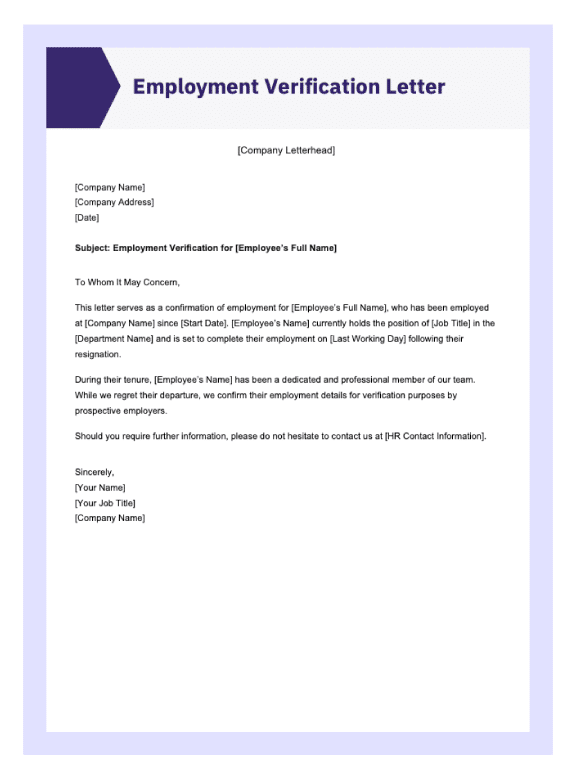
An employment verification letter follows a standard business letter format. Keep it to one page and use this order:
- Company letterhead: logo, company name, address, and contact details.
- Date: the date the letter is issued.
- Recipient: name and address of the requester, or “To Whom It May Concern”.
- Subject line: for example, “Re: Employment verification for [Employee name]”.
- Opening statement: one sentence confirming the person’s employment.
- Employment details: job title, employment dates, employment status, and salary if authorized.
- Purpose: the reason for the letter, such as a mortgage or visa application.
- Contact line: who to contact for follow-up verification.
- Closing and signature: signature, printed name, job title, and company stamp if required.
A few formatting tips help the letter get accepted the first time:
- Use a standard font, such as Arial or Calibri, at 10 to 12 points, with single spacing.
- Send the letter as a signed PDF so it can’t be edited.
- Check whether the requester accepts electronic signatures, as some immigration authorities ask for a handwritten signature.
Free employment verification letter template (Word, PDF)
AIHR has developed its own customizable employment verification letter template, which you can download for free at the link below.
How to write an employment verification letter in 5 steps
Use the following steps to help you write a clear, accurate, and compliant employment verification letter:
Step 1: Use a professional tone and clear language
Keep the letter formal and professional. Avoid overly casual language, as it can make your organization look unprofessional. However, you should also ensure the language in the letter is straightforward and easy to understand. This helps minimize confusion and delay in the process.
Step 2: Focus on relevant details
Provide essential employment details, including the employee’s full name, designation, and department, employment start date (and end date, if applicable), and employment type (full-time, part-time, contract, etc.). Only include salary information if the recipient has specifically requested it and the employee has given written consent.
Step 3: Keep the letter concise and structured
Organize the letter well and limit it to no more than one page. A simple employment verification letter does not need to be lengthy but should be short and to the point. Follow the standard format and use short paragraphs to enhance clarity and readability.
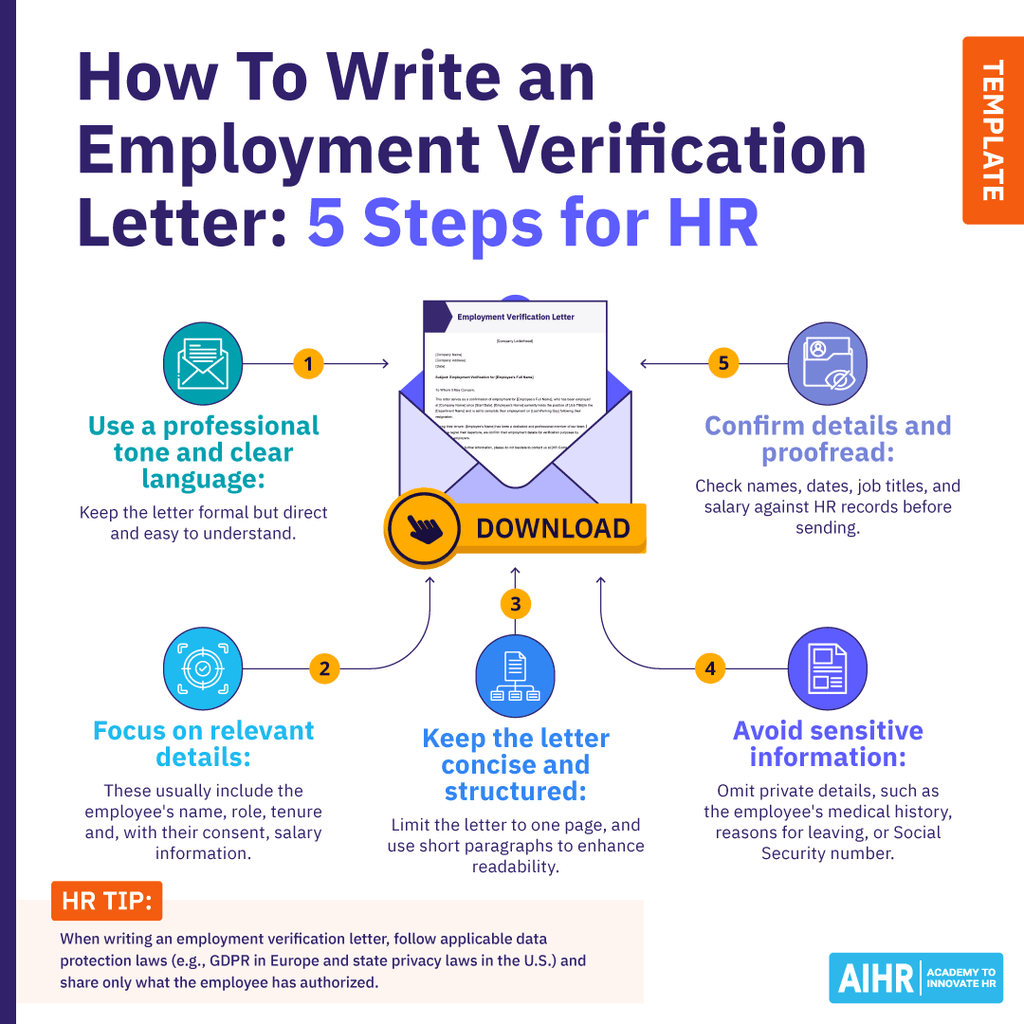
Step 4: Avoid unnecessary personal information
Omit private or sensitive information about the employee. This includes their medical history, the reasons for their resignation or termination of employment contract, and personal opinions of their performance during their tenure. While a medical condition or the reason for the employee’s departure may be relevant, include such details only if explicitly required. Leave out the employee’s Social Security number unless the requester’s own form specifically asks for it.
Step 5: Confirm details and proofread before sending
Verify names, job titles, employment dates, and salary (if required). Mistakes can cause delays or legal issues, so be sure to have the relevant HR personnel review letters before sending.
7 sample employment verification letters
Below are seven sample employment verification letters that cover different scenarios you might have to write such letters for:
Sample 1: Basic employment verification letter
[Company Letterhead]
[Company Name]
[Company Address]
[Date]
To Whom It May Concern,
This letter confirms that [Employee’s Full Name] is employed at [Company Name] as a [Job Title] in the [Department Name]. [Employee’s Name] has worked with us since [Start Date] on a [full-time/part-time/contract] basis.
This letter confirms employment details only and does not include compensation or performance information. The information above is accurate as of the date of this letter.
Should you require further verification, please contact us at [HR Contact Information].
Sincerely,
[Your Name]
[Your Job Title]
[Company Name]
Sample 2: Employment verification letter for an outgoing employee applying for a new job
[Company Letterhead]
[Company Name]
[Company Address]
[Date]
To Whom It May Concern,
This letter serves as a confirmation of employment for [Employee’s Full Name], who has been employed at [Company Name] since [Start Date]. [Employee’s Name] currently holds the position of [Job Title] in the [Department Name] and is set to complete their employment on [Last Working Day] following their resignation.
[Optional: During their tenure, [Employee’s Name] has been a dedicated and professional member of our team.] While we regret their departure, we confirm their employment details for verification purposes by prospective employers.
Should you require further information, please do not hesitate to contact us at [HR Contact Information].
Sincerely,
[Your Name]
[Your Job Title]
[Company Name]
Sample 3: Employment verification letter for a former employee applying for a new job
[Company Letterhead]
[Company Name]
[Company Address]
[Date]
To Whom It May Concern,
This letter is to verify that [Former Employee’s Full Name] was employed at [Company Name] from [Start Date] to [End Date]. During their time with us, they held the position of [Job Title] in the [Department Name].
We confirm that [Former Employee’s Name] left the company in good standing. Please note that this letter solely confirms their employment and does not serve as a testimonial to their job performance.
Should you require further details, you may contact us at [HR Contact Information].
Sincerely,
[Your Name]
[Your Job Title]
[Company Name]
Sample 4: Employment verification letter for a current employee applying for a loan or mortgage
[Company Letterhead]
[Company Name]
[Company Address]
[Date]
To Whom It May Concern,
This letter confirms the employment status of [Employee’s Full Name], who has been employed with [Company Name] since [Start Date]. They currently hold the position of [Job Title] and are a [Full-time/Part-time/Contract] employee.
Their current annual salary is [Salary Amount], and they are paid [weekly/monthly/biweekly]. This verification is being provided at the request of [Bank/Lender Name] for the purpose of processing a loan/mortgage application.
Should you need further information, please contact us at [HR Contact Information].
Sincerely,
[Your Name]
[Your Job Title]
[Company Name]
Sample 5: Employment verification letter for a current employee applying for a visa
[Company Letterhead]
[Company Name]
[Company Address]
[Date]
To Whom It May Concern,
This letter is to confirm that [Employee’s Full Name] has been employed with [Company Name] since [Start Date] and currently holds the position of [Job Title]. They are employed on a [full-time/part-time] basis and receive an annual salary of [Salary Amount]. In this role, [Employee’s Name] is responsible for [2–3 key responsibilities].
This verification is being provided in support of their [visa application/immigration request/work permit application]. [Employee’s Name] remains in active employment, and we foresee no changes to their employment status at this time.
If you require any additional details, please contact us at [HR Contact Information].
Sincerely,
[Your Name]
[Your Job Title]
[Company Name]
Sample 6: Employment verification letter for an employee applying to rent a property
[Company Letterhead]
[Company Name]
[Company Address]
[Date]
To Whom It May Concern,
This letter serves as verification of employment for [Employee’s Full Name], who is currently employed at [Company Name] as a [Job Title] in the [Department Name]. [Employee’s Name] has been working with us since [Start Date], and their employment status is [full-time/part-time/contract].
As of today, their gross annual salary is [Salary Amount], and they receive their wages on a [weekly/monthly/biweekly] basis. This letter is provided upon request for their rental application purposes.
Should further verification be required, please feel free to reach out to us at [HR Contact Information].
Sincerely,
[Your Name]
[Your Job Title]
[Company Name]
Sample 7: Income verification letter for an employee applying for government benefits
[Company Letterhead]
[Company Name]
[Company Address]
[Date]
To Whom It May Concern,
This letter verifies the employment and income of [Employee’s Full Name], who has been employed at [Company Name] since [Start Date]. [Employee’s Name] currently holds the position of [Job Title] on a [full-time/part-time/seasonal] basis.
[Employee’s Name] earns [hourly rate/annual salary] and works an average of [Number] hours per week. They are paid on a [weekly/biweekly/monthly] basis, with gross earnings of [Amount] over the past [Number] months.
This information is provided at [Employee’s Name]’s request and with their authorization, in support of their application for [Program Name]. The information above is accurate as of the date of this letter.
Should you require further information, please contact us at [HR Contact Information].
Sincerely,
[Your Name]
[Your Job Title]
[Company Name]
Expert insight: What steps should I take if a former employee terminated for misconduct requests an employment verification letter?
AIHR’s Senior HR Solutions Advisor, Suhail Ramkilawan, advises doing the following:
- Check if there’s an organizational policy in place to guide such requests and if there are any legal obligations to consider
- Avoid any defamation. The mention of misconduct can be omitted unless legally required
- Ensure you handle all these requests consistently.
If it’s possible to do so and your organization is not legally required to provide an employment verification letter, consider declining the request. This may depend on your organization’s policies, as well as local legislation.
Best practices for handling employment verification requests
As an HR professional, handling employment verification requests requires attention to detail, professionalism, and legal compliance. The following best practices ensure each letter serves its purpose effectively:
- Stay updated on labor laws and privacy regulations: Ensure compliance with local labor and privacy laws. Some regions restrict sharing salary history or termination reasons without consent. Consult legal or compliance teams before issuing letters in sensitive cases.
- Be mindful of third-party requests: Confirm the legitimacy of the requester before issuing a letter. If unsure, double-check with the employee, and require employees to request verification through HR.
- Keep a record of the letter: Always retain a copy of the employment verification letter in the employee’s HR file for future reference, compliance checks, or legal protection. Be sure to store records in a secure HR database.
- Protect employee confidentiality: Be cautious when handling requests over the phone or email. Ensure the employee has authorized the verification request, and require them to submit a signed request form before you issue a verification letter.
To sum up
Employment verification letters require accuracy, consistency, and careful handling of employee data. A clear process helps you respond efficiently and professionally.
To build broader talent management skills, explore AIHR’s Talent Management & Succession Planning Certificate Program. You’ll learn how to manage talent pipelines, develop future leaders, and strengthen succession planning.