



Handling employee terminations and writing termination letters are routine parts of many HR roles. In the U.S., Bureau of Labor Statistics data regularly show around 1.6 million layoffs and discharges in a month, which underlines how common employer-initiated separations are.
A well-written employee termination letter helps employers document the decision clearly, reduce the risk of misunderstandings or legal disputes, and handle the process professionally and with respect.
In this guide, you’ll learn how to write a clear, professional employment termination letter, what to include, and how to adapt it to different situations. You’ll also find a free termination letter template (in Word and PDF) and practical examples to help you get started.
Contents
What is a termination letter?
What to include in an employee termination letter
Free termination letter template (Word & PDF)
6 termination letter examples (and samples)
How to write a simple termination letter
Checklist before sending an employment termination letter
FAQ
What is a termination letter?
A termination letter is a formal written notice from an employer to an employee confirming that their employment is ending. Also called an employee termination letter, letter of termination, notice of termination, dismissal letter, or termination of employment letter, it records the decision in writing and outlines key details such as the effective date, next steps, final compensation, benefits, and any obligations the employee must meet before leaving.
A job termination letter helps employers document the separation clearly and communicate it professionally. It also gives employees a written record of the decision and explains what they need to do before they leave the organization. In some cases, the letter may include the reason for termination, but employers should always follow company policy and applicable employment laws when deciding what to include.
Why are termination letters important?
A termination letter gives employers a clear written record of the decision to end the employment relationship. It helps HR teams communicate important details, handle the process more professionally, and reduce the risk of misunderstandings or disputes.
A termination letter matters because it helps employers:
- Document the termination decision in writing
- Confirm the employee’s final working day
- Explain final pay, benefits, and other next steps
- Create a consistent offboarding process
- Provide a clear record if the employee applies for unemployment benefits
- Reduce confusion and support better recordkeeping.

Are termination letters legally required?
In the U.S., federal law does not generally require employers to provide a termination letter. However, written notice may be required in specific situations:
- Mass layoffs and plant closings: Under the federal WARN Act, covered employers must give at least 60 calendar days’ written notice. Some states have their own WARN laws with broader coverage. For example, New York’s WARN Act requires 90 days’ notice from employers with 50 or more full-time employees.
- State termination notice rules: Some states require written notice of the termination itself. For example, New York requires employers to give written notice of the exact termination date and the date benefits end within five working days of the termination.
- State separation notices for unemployment: Some states require employers to give departing employees a specific form or notice so they can apply for unemployment benefits. For example, Georgia requires employers to complete the Separation Notice (DOL-800) for every worker who leaves, whatever the reason. California requires a written Notice to Employee as to Change in Relationship and the For Your Benefit (DE 2320) pamphlet for discharged or laid-off employees.
Even when a termination letter isn’t legally required, many employers still use one to document the separation. Because termination rules vary by state, review applicable laws and internal policies before issuing a letter.
Termination letter vs. separation letter
A separation letter, also called a letter of separation or separation of employment letter, confirms that employment has ended for any reason. A termination letter is the letter an employer issues when it decides to end employment.
Who initiates the exit
The employer
The employer or the employee
When it’s used
Termination for cause, poor performance, layoff, at-will termination, or probationary termination
Any exit, including resignation, retirement, layoff, termination, or the end of a fixed-term contract
Main purpose
Notifies the employee of the employer’s decision and documents it
Confirms that employment has ended and what happens next
Reason for leaving
Often included when company policy or law requires it
Usually states the type of separation, such as resignation or position elimination
Typical content
Termination date, reason where appropriate, final pay, benefits, return of company property, HR contact
Last working day, final pay, benefits, return of company property, HR contact
What to include in an employee termination letter
A termination letter should clearly explain the decision and give the employee the practical information they need before leaving the organization. When employers include the right details, they communicate more clearly, reduce confusion, and create a stronger record of the separation process.
Here’s what to include in a termination letter:
- Employee and role details: Identify the employee by name, state their job title, and date the letter. This makes it clear who the letter applies to and when it was issued, and helps avoid confusion in internal records.
- Termination date: Clearly state the date employment ends. This gives the employee a clear understanding of their final working day and helps define the timeline for pay, benefits, and offboarding.
- Reason for termination: Explain the reason for the decision when appropriate or when company policy or local law requires it. Keep the wording clear and factual, and avoid language that sounds emotional or accusatory.
- Relevant context: Briefly summarize the circumstances that led to the decision, such as prior warnings, performance concerns, policy violations, or organizational changes. This helps document the separation more clearly, especially when the termination does not come out of the blue.
- Final pay information: Explain what the employee will receive in their final paycheck, including outstanding wages and any unused leave payout if applicable. You can also note when and how the payment will be made. Federal law doesn’t require immediate final pay, but some states set strict deadlines, so check your state’s rules before confirming the date.
- Benefits and severance details: Outline what happens to the employee’s benefits after termination and include severance information if the employer is offering it. If relevant, mention continuation options such as COBRA, which generally applies to employers with 20 or more employees, and tell the employee where they can find more information.
- Company property return instructions: List any company property the employee must return, such as a laptop, ID badge, keys, or documents. Also, explain how, when, and where they should return these items.
- Next steps and ongoing obligations: Close the letter by explaining any remaining actions the employee must take and reminding them of any obligations that continue after employment ends, such as confidentiality or non-disclosure agreements. Include a contact person if the employee has follow-up questions.
- Signature and acknowledgment: Have the manager or HR representative sign the letter. You can also add a line for the employee to sign and date as confirmation of receipt, which strengthens your records.
Also, remember that the tone of a termination letter is crucial. It should be respectful and unambiguous to maintain the employee’s dignity while safeguarding the company’s reputation. A well-crafted letter reflects the organization’s commitment to fairness and transparency.
A termination letter is just one part of a sensitive offboarding process. Learn to manage these situations consistenly and respectfully by developing a broader understanding of HR policies, employee relations, and workplace communication.
The HR Generalist Certificate Program helps you:
✅ Handle sensitive employee conversations with greater confidence and professionalism
✅ Apply HR policies and processes consistently across terminations and offboarding
✅ Communicate clearly during high-stakes workplace moments
✅ Strengthen employee relations skills across the full employee life cycle
🚀 Visit the AIHR Demo Portal to preview lessons and see how the program can support your HR work.
Free termination letter template (Word & PDF)
To help make the termination process easier, AIHR has created a free, customizable employee termination letter template, available in Word and PDF formats. HR teams can adapt it to different termination scenarios, and it follows a standard termination letter format.
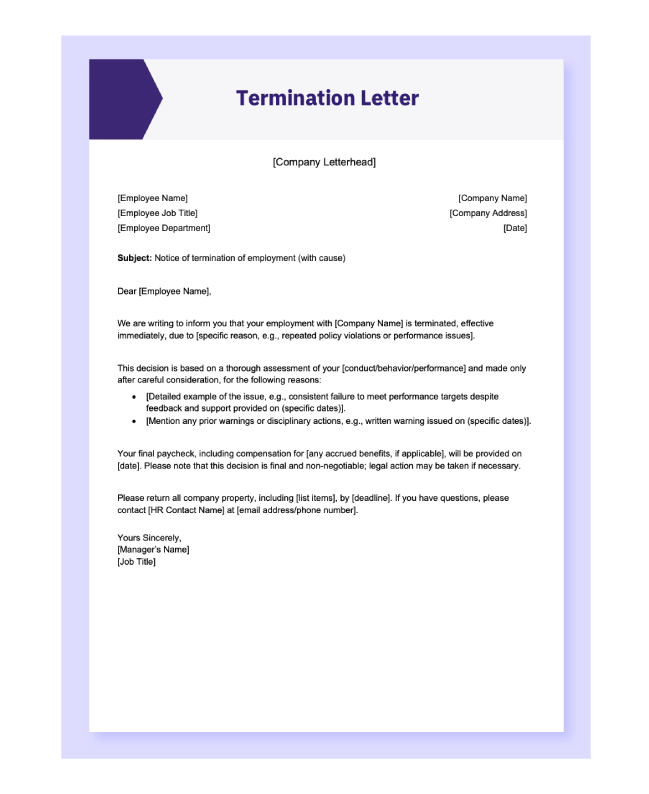
Please note: This template is only intended for general usage and does not constitute professional or legal advice. To ensure your termination letter is legally compliant, consult with a qualified legal professional.
6 termination letter examples (and samples)
Here are sample termination letters that apply to different scenarios. You can edit them to reflect your company’s policies and tone, or trim them into a short termination letter for straightforward cases.
Use this table to choose a sample termination letter for your situation:
Serious misconduct or a documented policy violation
Confirm the findings and whether immediate termination is appropriate.
Unmet performance expectations
Match the explanation to documented expectations, feedback, and support.
A fixed-term employment contract reaches its end
Check the end date, notice requirements, and renewal terms.
A role is eliminated for business reasons
Check notice obligations, benefits, and any severance offer.
An at-will employment relationship ends
Confirm the arrangement and check for unlawful reasons or other restrictions.
Employment ends during probation
Check contractual terms and documented role expectations.
Example 1: Immediate termination letter for cause
Use this sample letter when the employer ends employment because of serious misconduct, policy violations, or other behavior that justifies immediate termination. In these cases, HR may need to issue an immediate termination letter.
Example 2: Termination letter for poor performance
Use this sample letter when the employer ends employment because the employee has not met performance expectations despite feedback, support, or prior warnings.
Example 3: End of employment letter for a fixed-term contract
Use this sample letter when a fixed-term employment contract ends, and the employer does not plan to renew it.
Example 4: Layoff termination letter
Use this sample letter when the employer ends employment because of restructuring, downsizing, cost-cutting, or other business changes, rather than the employee’s conduct or performance.
Example 5: At-will termination letter
Use this sample letter when the employer ends an at-will employment relationship in accordance with company policy and applicable law. At-will employment applies in every state except Montana, where state law requires good cause to dismiss an employee who has completed the probationary period.
Example 6: Probationary period termination letter
Use this sample letter when the employer ends employment during the probationary period because the employee is not meeting the expectations of the role or is not a good fit for the position.
How to write a simple termination letter
Follow these steps to write a termination letter or termination notice in the standard format.
Step 1: Use a professional letterhead
Start with your company’s letterhead, and include the company’s name, address, and contact details. This is an important part of standardizing your organization’s termination letters. Be sure to also include the date to establish the document’s formal timeline.
Step 2: Address the letter to the employee
Include all relevant employee details, such as their full name, job title, and, if applicable, their employee ID. Then, begin the letter itself with a formal salutation (e.g., “Dear [Employee’s Name]”).
Step 3: Clearly state the intent to terminate
Open with a direct statement of the intent to terminate employment and specify the effective termination date. For instance: “We are writing to inform you that your employment with [Company Name] will be terminated, effective [Date].” This is the core of the written termination notice and should be clear and unambiguous.
Step 4: Provide a reason for termination when appropriate or required
If company policy or local law calls for it, explain the reason for termination, whether with or without cause. Be factual and concise to avoid ambiguity or emotional language (e.g., “This decision is based on repeated performance issues despite efforts to address them through constructive feedback.”).
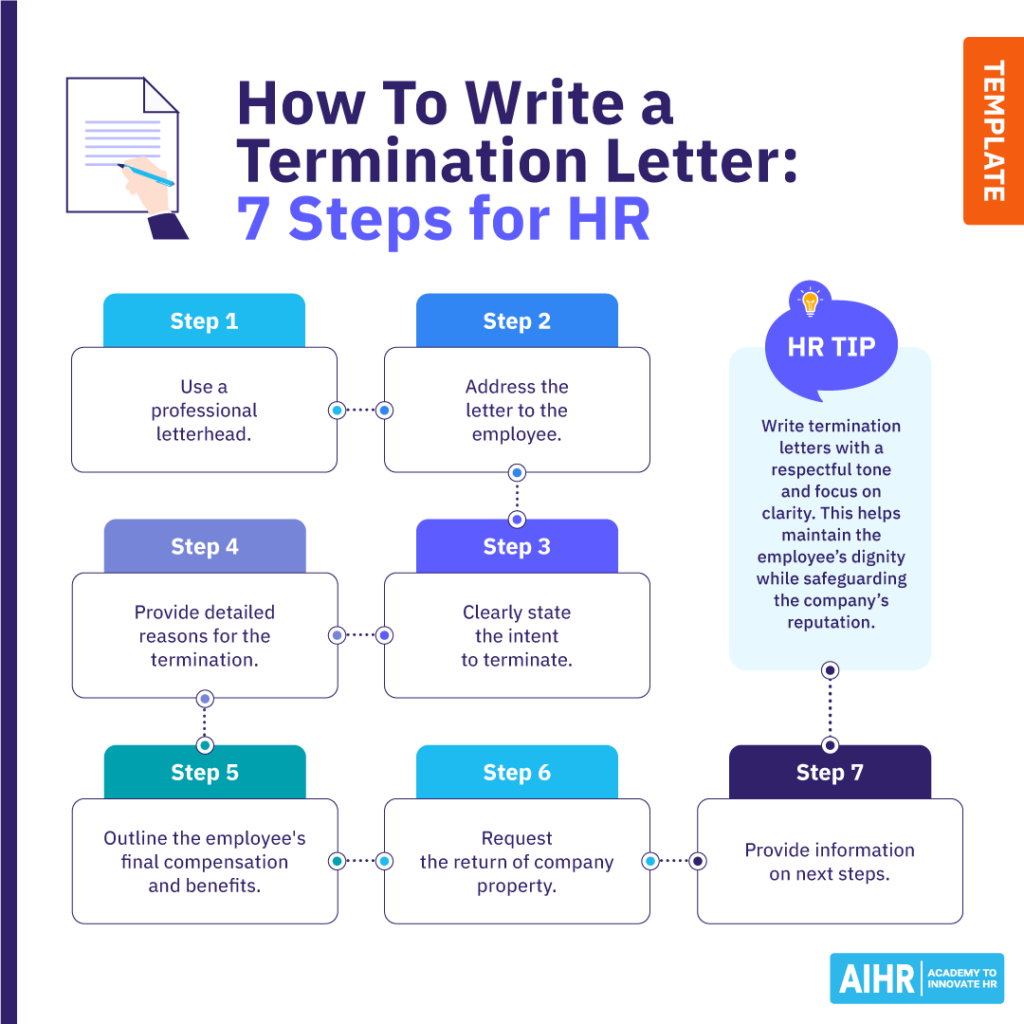
Step 5: Outline the employee’s final compensation and benefits
Provide details about the employee’s final paycheck, including payment for unused leave, overtime, or any other due compensation. Also, mention severance pay (if applicable), continuation of benefits such as COBRA, and how the employee can collect these payments.
Step 6: Request the return of company property
List all company property the employee must return, such as laptops, ID cards, or keys. Specify a deadline and how these items should be returned. For example: “Please return all company-issued property, including your laptop and access badge, by [Date].”
Step 7: Provide information on next steps
Offer a point of contact for the employee to direct their questions to (typically someone from HR). If applicable, mention any additional support, such as career counseling, references, or job placement assistance. Close the letter with the signature of the manager or HR representative and, if you use one, a line for the employee to acknowledge receipt.
HR tip
If you need to send a termination letter by email, share the decision in a meeting or call first. Then email the letter as a PDF to the employee’s work and personal addresses, ask them to confirm receipt, and keep a copy on file. Check your state’s rules before emailing any legally required notices.
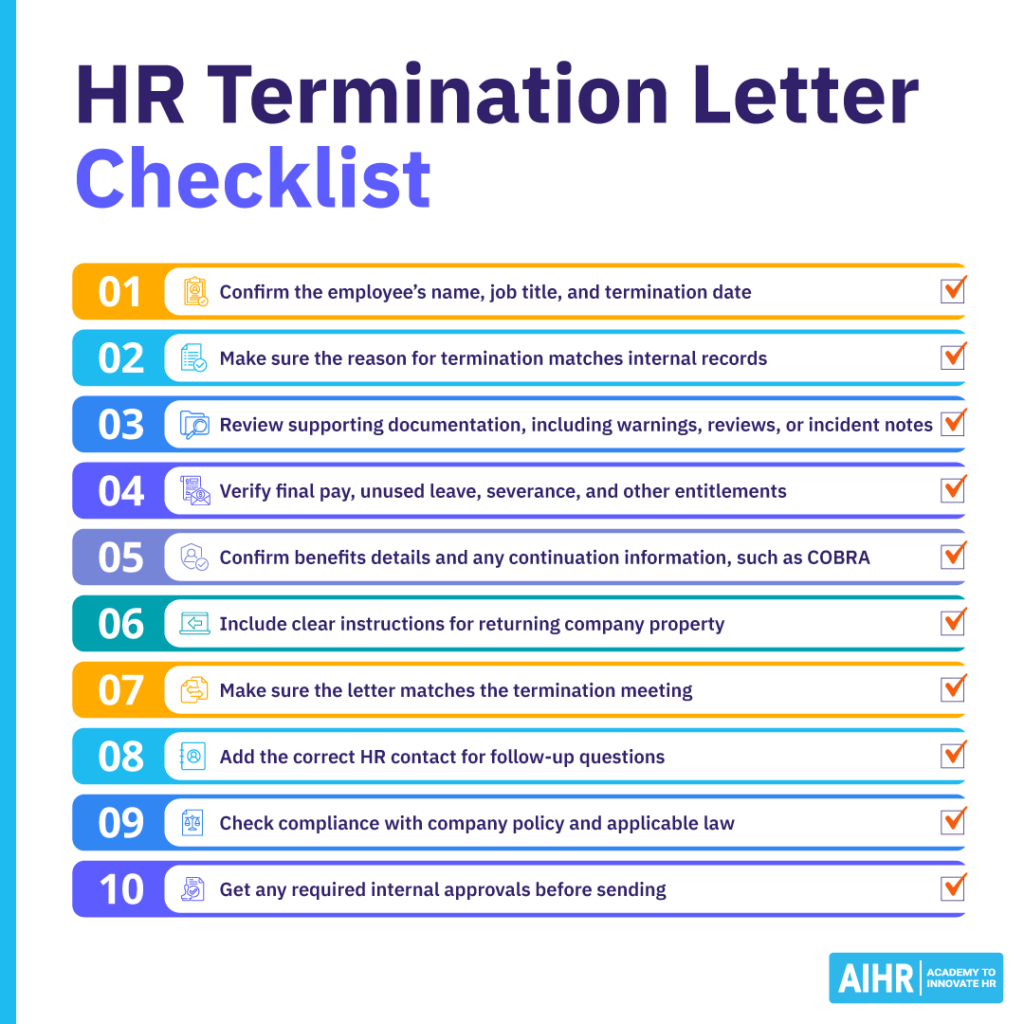
Checklist before sending an employment termination letter
Before sending a termination letter, review both the letter and the supporting documentation carefully. This helps HR confirm that the information is accurate, the process is consistent, and the organization has a clear record of the decision.
Here’s what to check before you send it:
- ✔ Confirm the employee’s full name, job title, and termination date
- ✔ Check that the reason for termination is accurate and consistent with internal records
- ✔ Review any supporting documentation, such as performance reviews, warnings, incident reports, or policy acknowledgments
- ✔ Verify final pay details, including outstanding wages, unused leave payout, severance, and any other entitlements where applicable
- ✔ Confirm what happens to the employee’s benefits and whether continuation information, such as COBRA, should be included
- ✔ Make sure instructions for returning company property are complete and practical
- ✔ Check that the letter matches what will be communicated during the termination meeting
- ✔ Add the correct HR contact for follow-up questions
- ✔ Review the letter for compliance with company policy and applicable federal or state laws
- ✔ Get any required internal approvals before sending the letter.
A final review can help HR catch errors, confirm that the letter matches the documentation, and make sure the process is handled consistently. It also gives the employee clearer information about their separation and next steps, which can reduce confusion at a difficult time.
Next steps
A clear, respectful termination letter is one part of handling a termination well. Use the template and samples above as your starting point, and adapt them to your company policy and state requirements before sending.
To manage terminations and the wider offboarding process with more confidence, build your skills in employee relations, documentation, and HR compliance. AIHR’s HR Generalist Certificate Program helps you develop end-to-end HR process knowledge across the employee life cycle.
FAQ
A termination letter is a formal written notice from an employer confirming that an employee’s employment is ending. It typically includes key details such as the termination date, reason for separation where appropriate, final pay, benefits, and next steps.
A good termination letter clearly states that employment is ending, includes the effective date, explains the reason when appropriate, and outlines next steps such as final pay, benefits, and the return of company property. It should be direct, professional, and respectful.
A termination letter should not include emotional language, personal opinions, vague accusations, or unnecessary details that could create confusion or legal risk. It should also avoid insulting wording, contradictory information, or promises the employer cannot support. Keep the format and tone consistent across all termination letters, and store signed copies securely in the employee’s file.
Yes, a dismissal letter is generally the same as a termination letter. Both refer to a formal written notice from an employer confirming that an employee’s employment is ending. In HR, the term “termination letter” is more commonly used, especially in formal documentation. However, “dismissal letter” is often used interchangeably, particularly in regions like the UK.
To politely terminate an employee, communicate the decision directly but with empathy and respect. Use clear, straightforward language, avoid blaming or overly personal remarks, and focus on the facts of the decision rather than debating it. During the conversation and in the termination letter, acknowledge that this is a difficult moment, explain any immediate next steps, and give the employee space to ask practical questions. A respectful, well-prepared approach helps protect the employee’s dignity while also supporting a fair and professional offboarding process.
In most states, an employee doesn’t need a termination letter to file for unemployment benefits. The state unemployment agency usually contacts the employer directly to confirm the reason for separation. However, some states require employers to give departing employees a specific separation notice, and a clear termination letter helps the employer respond accurately if the agency requests information.