


The HR to employee ratio is a valuable metric for assessing whether your organization has the right number of HR professionals to meet workforce needs and support broader business goals. But there’s no one-size-fits-all number. The “ideal” ratio varies depending on a range of factors, including company size, industry, structure, and level of digital maturity.
In this article, we’ll walk through what the HR to employee ratio is, why it matters, how to calculate it, and how to use it effectively. We’ll also explore benchmark data, share examples, and highlight best practices to help you evaluate and optimize your own HR staffing levels.
Contents
What is the HR to employee ratio?
Why is the HR to employee ratio important?
What is the ideal HR to employee ratio?
How many HR staff do you need?
How to calculate HR to employee ratio
HR to employee ratio calculator
HR to employee ratio best practices
FAQ
What is the HR to employee ratio?
The HR to employee ratio (also known as the HR to staff ratio or HR staffing ratio) measures the number of HR professionals relative to the total number of employees in an organization. It offers a snapshot of how well your HR function is resourced and how efficiently it operates.
A high HR staff to employee ratio (meaning more HR professionals per employee) may indicate lower efficiency or over-resourcing. However, this isn’t always the case; a higher ratio may reflect a service-intensive HR function, high-touch operations, or greater complexity in regulatory compliance or workforce management.
On the flip side, a lower ratio might indicate lean operations or strong automation, but could also signal under-resourcing, which increases the risk of burnout or gaps in employee support.
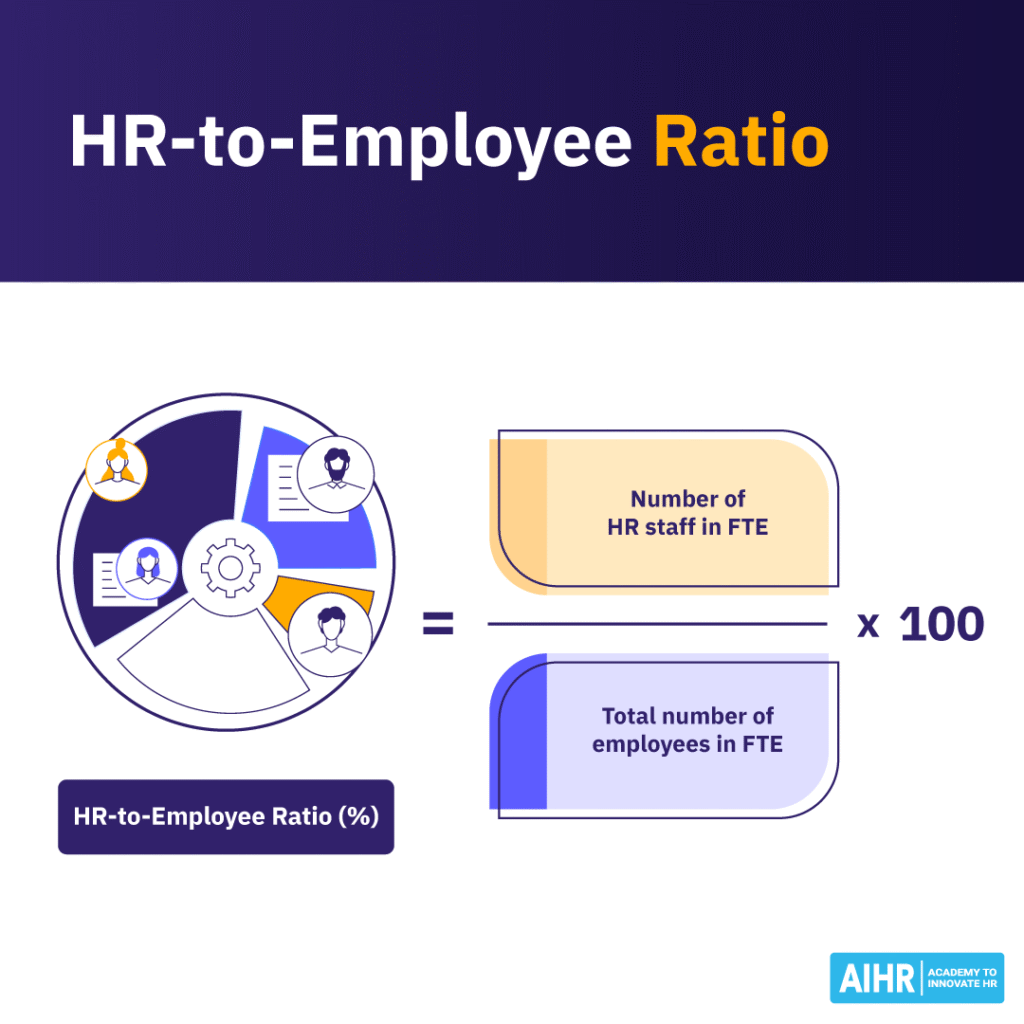
To calculate the HR to employee ratio, you can use the following formula:
HR to employee ratio (%) = (Number of HR staff in FTE / Total number of employees in FTE) × 100
Let’s take a look at an example:
A fast-growing scale-up has 2,045 employees (1,860 full-time equivalents or FTEs). The HR team consists of 35 people (32 FTEs). The HR Director, Jill, is concerned about workload pressure and wants to make a case for increasing her team’s headcount.
For this, she uses the ratio formula:
(32 / 1,860) × 100 = 1.7%
Since this result — 1.7%—is well below the HR to employee ratio benchmark for companies of a similar size, it gives Jill an additional, data-driven argument for increasing the HR team size. Still, other factors, such as the degree to which HR is strategic, technological capabilities, and budget control, must be considered when interpreting this metric.

Why is the HR to employee ratio important?
The Jill example mentioned in the previous section demonstrates one reason why knowing your organization’s HR to employee ratio is helpful. Other reasons include:
Signals HR capacity and efficiency
A low ratio — for example, 1:100 (one HR professional per 100 employees, based on headcount rather than FTE) — can suggest a streamlined HR function, particularly if automation is in place. But it can also point to overstretched staff and the risk of burnout, especially if HR is expected to support strategic initiatives like employee experience, leadership development, or DEIB.
On the other hand, a higher ratio — such as 1:50 or even 1:20 — typically reflects a more service-intensive HR approach. This is common in organizations focused on talent development, rapid change, or with complex compliance requirements.
Bear in mind that what typically counts as a ‘high’ or ‘low’ ratio depends on, among other things, the organization’s size and structure.
Staffing levels also affect turnover. ADP Research Institute found that turnover starts to fall once a company has at least one HR staff member for every 200 employees, but begins climbing again once HR staffing exceeds 9 per 200. Both under- and over-staffing HR can work against you.
Understanding your HR to employee ratio is only the first step—what you do with that insight shapes your team’s ability to support the business.
With AIHR for Business, your team will learn to:
✅ Learn how to evaluate and plan HR staffing based on strategic goals
✅ Identify opportunities to improve efficiency with technology and upskilling
✅ Build workforce planning capabilities using data, not guesswork
✅ Develop the expertise to align HR structure with business complexity
🎯 Make smarter decisions about HR resourcing with a team that’s ready to scale.
Helps benchmarking against industry standards
Once you know your ratio, you can compare it with other organizations in your industry.
For example, in healthcare, ratios between 1:30 and 1:50 can be quite common due to dynamic scheduling demands and heavy compliance requirements. If your healthcare organization has one HR professional for every 75 employees, you may be under-resourced.
Failing to do so may lead to an overworked and eventually burned-out HR team and, by extension, increased job dissatisfaction among the organization’s other employees.
Informs strategic workforce planning
Together with other elements, the HR staffing ratio supports decision-making about hiring more people for the HR team or, on the contrary, reducing the number of people on the team.
For example, comparing your ratio with the average HR to employee ratio during a period of organizational growth following a merger or acquisition provides more accurate insights into current and future needs.
Improves employee experience
An optimal HR to employee ratio helps ensure employees receive timely, personalized support from HR. The right level of service makes a difference: it improves engagement, productivity, and satisfaction. Underserved employees, meanwhile, may feel disconnected or unsupported, especially when HR is stretched too thin.
Four additional reasons to get your ratio right
Recent data from Perceptyx’s State of Employee Listening report highlights how under-resourcing HR is taking a toll:
- 33% HR leaders experience mental and physical exhaustion
- 25% say they are already burned out
- 40% say their jobs have become significantly more challenging over the past year
- 30% have considered leaving the HR profession altogether.
What is the ideal HR to employee ratio?
There’s no single ideal HR to employee ratio that fits every organization. The right number depends on several factors, including company size, structure (centralized vs. decentralized), industry, and how HR operates within the business.
For instance, decentralized organizations may need more HR professionals to manage different locations. Industries like healthcare or manufacturing often require additional HR capacity due to compliance, safety training, and labor regulations.
Still, HR to employee ratio benchmark(s) can offer a helpful point of comparison. Here are a few recent ones:
- The ADP at Work report states: 2.6 HR professionals for every 100 employees.
- Forbes, in an article about key HR statistics and trends:
- 3.4 per 100 in small organizations.
- 1.22 per 100 in medium-sized companies
- 1.03 per 100 in large companies.
- SHRM’s Human Capital Benchmark Report: 1.7 HR professionals for every 100 employees.
- CIPD’s survey of UK-based HR leaders: One HR professional for every 60 employees.
- Bloomberg Law’s HR Benchmarks Report: 1.5 HR staff per 100 employees.
- Gartner’s HR efficiency benchmarking research: One HR FTE for every 58 employees.
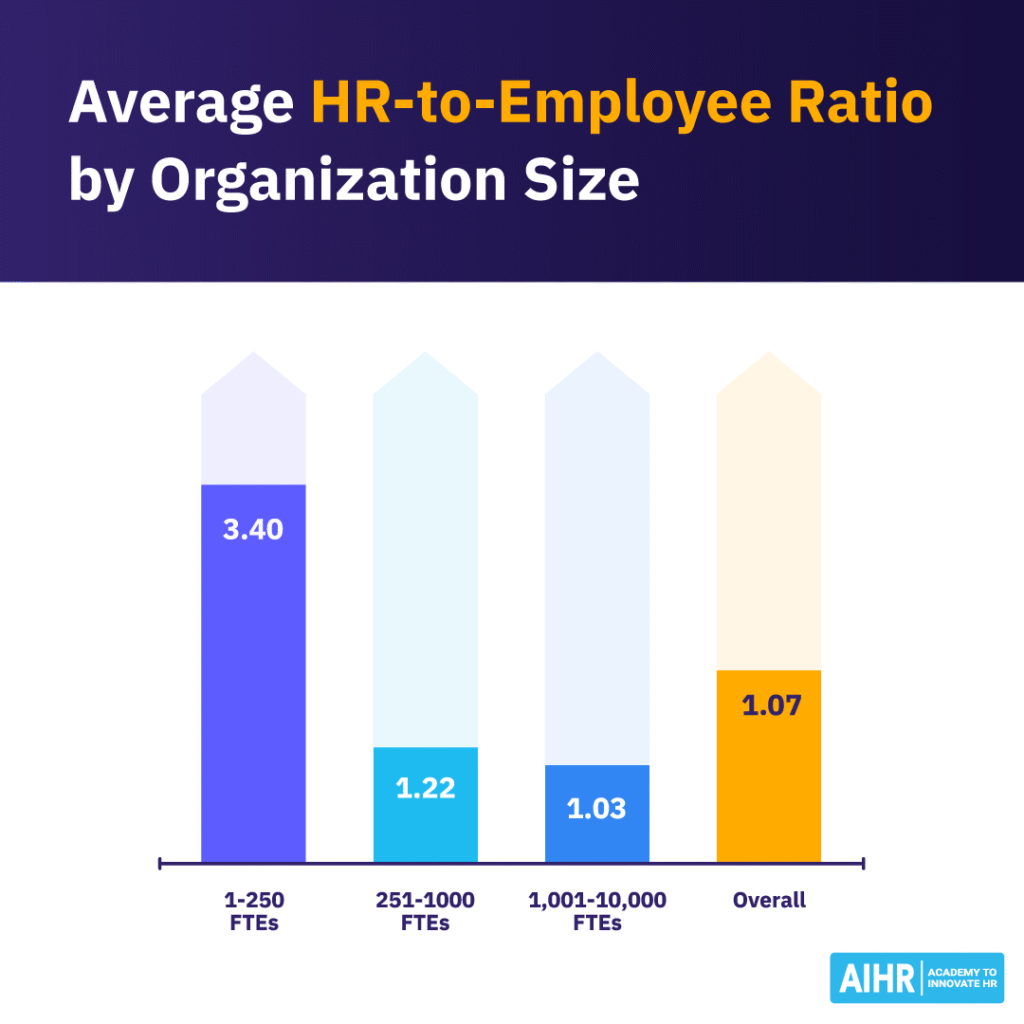
Most of these benchmarks cluster around 1.5 to 1.7 HR professionals per 100 employees, based on headcount. Gartner’s figure looks leaner because it counts HR FTEs specifically, which naturally produces a lower number than headcount-based benchmarks.
In other words, the only correct answer to the question of what the ideal HR staffing ratio is is that it depends. You can use data on the HR to employee ratio by industry or benchmarks like the ones listed above, but your optimal HR to employee ratio depends on a multitude of factors unique to your organization. On top of the ones mentioned above (size, industry, structure), these can include:
- The company’s level of digital maturity (e.g., HR automation and self-service tools)
- The strategic vs. operational role of HR
- Budget availability and who controls staffing decisions
- Whether or not your employees are unionized (and if so, to what extent).
How many HR staff do you need?
Use the benchmarks above as a starting point, then adjust them based on your company’s size, complexity, and HR operating model.
50
1–2
100
2–3
250
3–4
500
6–9
1,000
10–17
5,000
52–85
These ranges combine Forbes’ company-size-specific data (3.4 HR staff per 100 employees for small organizations, 1.22 for mid-sized, 1.03 for large) with SHRM’s overall average of 1.7 HR staff per 100 employees. Where your organization falls within each range depends on the factors covered above. These include industry, compliance complexity, unionization, and digital maturity.
How to calculate HR to employee ratio
To determine how effectively your HR team is scaled to support your workforce, you’ll want to use the HR to employee ratio formula. This calculation expresses how many HR professionals are employed for every 100 employees in the organization.
Here’s a reminder of what the formula looks like:
HR to employee ratio = (Number of HR FTEs / Total number of employee FTEs) × 100
*Note: FTE stands for Full-Time Equivalent. A part-time employee working 50% of full-time hours would count as 0.5 FTE.
As you can see, the ratio expresses the number of HR staff in FTE, or Full-Time Equivalent, divided by the number of total staff in the organization, also expressed in FTE, multiplied by 100 to get the result as a percentage.
Example 1: Small company
An Amsterdam-based fintech start-up currently has 55 employees, including 2 HR people. Its HR staffing ratio, therefore, is:
HR to employee ratio = (2/55) * 100 = 3.6%
This means that the company has 3.6 HR professionals for every 100 employees.
Example 2: Mid-sized business
A US-based company specializing in digital marketing services has 380 employees worldwide (300 FTEs) and an HR department of 8 people (6 FTEs). Its ratio is:
HR to employee ratio = (6/300) * 100 = 2%
Here, there are 2 HR staff per 100 employees.
Note that in the second example, and according to the HR to employee ratio formula, we use the FTEs to calculate the staffing ratio, not the actual number of employees in the company.
HR to employee ratio calculator
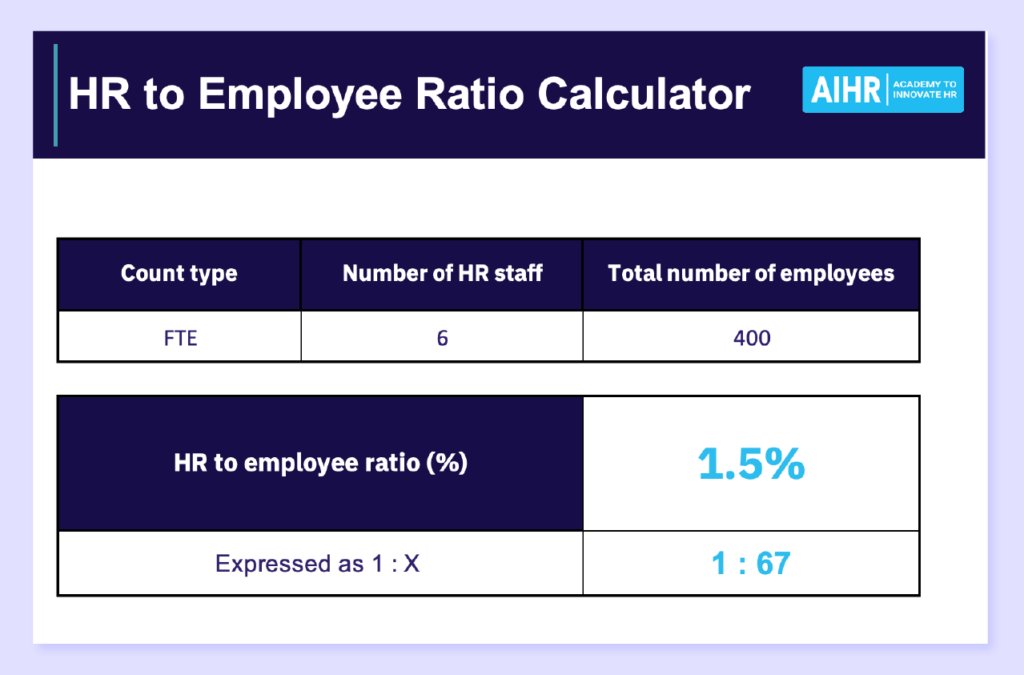
Use this HR to employee ratio calculator to quickly estimate how many HR staff members your organization has for every employee. This helps you benchmark HR capacity, compare team size across organizations, and understand whether your HR function has enough support to meet business and workforce needs.
HR to employee ratio best practices
The HR-to-employee ratio helps organizations understand how well their HR team is resourced to support the workforce. While there’s no ideal number for every company, a few practical guidelines can help you decide what makes sense for your setup.
1. Align the ratio with business needs and strategy
There’s no universal target for the HR to employee ratio, as it depends on what your business needs from HR. This ratio varies by:
- Industry: Manufacturing firms often run lean (e.g., 1:150), while professional services or tech companies might have closer to 1:50.
- Business complexity: Global operations, unionized workforces, or M&A activity typically require more HR support.
- Organizational maturity: Startups might rely on generalists or outsourced HR, whereas larger companies build specialized HR teams.
2. Factor in HR technology and outsourcing
Companies using HRIS, automation, or outsourced services can operate with lower ratios without sacrificing effectiveness. For example:
- A self-service HR portal might reduce the need for administrative HR staff.
- Outsourced payroll or benefits administration allows in-house HR to focus on strategy and culture.
However, too much reliance on tech without human support can erode the employee experience, especially in areas like onboarding, ER, or L&D.
3. Assess HR’s scope of responsibility
Not all HR teams are structured the same. Some focus mostly on compliance and payroll, while others handle broader functions such as employee development, internal communications, succession planning, and DEIB initiatives. The broader and deeper the scope, the more staff you’ll need to manage it well. A team tasked with driving cultural change or upskilling leaders needs more time and specialization than one focused on administrative support.
4. Track changes over time
Your HR ratio should shift along with your organization. Rapid growth, business restructuring, or expansion into new markets all impact the level of HR support needed. If the HR team is stuck operating with a ratio that made sense two years ago but no longer fits, things start to slip, like onboarding quality, policy compliance, or employee engagement. It’s worth reassessing the ratio annually or during any major business shift.
5. Use the ratio as a starting point, not a verdict
The HR to employee ratio is useful, but only part of the picture. A seemingly lean ratio might look efficient, but if the team is overwhelmed, it’s not sustainable. Instead of focusing only on the number, think about outcomes:
- Is the business getting what it needs from HR?
- Are HR goals tied to measurable business outcomes?
- What’s the ROI of expanding the HR team?
A slightly higher ratio might bring long-term value by improving retention, performance, and overall employee satisfaction.
To sum up
The HR to employee ratio is a valuable metric for assessing HR team capacity and efficiency, especially when paired with other organizational data. While benchmarks can provide guidance, the ideal ratio depends on factors like industry, company size, structure, and HR’s strategic role. Use it as a starting point to evaluate your HR resourcing, not a final answer.
FAQ
It’s difficult to establish a healthy HR to employee ratio that is valid across all organizations and industries. The ideal number depends on multiple factors, including organizational size, structure, industry, the level of unionization and digitalization, budget, and staffing budget control.
This varies depending on your company’s structure, technology use, and HR priorities. Based on benchmark data, having 2 to 4 HR staff for 200 employees (a ratio between 1:50 and 1:100) is a common starting point, but this number may be higher in industries with more complex compliance or high turnover.
Most benchmarks put it around 1.5–1.7 HR professionals per 100 employees (SHRM), with ADP citing a wider “sweet spot” of 1.5–4.5 per 100, and Indeed reporting an overall average of 2.57. Note that the classic “1:100” figure is a headcount ratio, not FTE, so it won’t match the FTE-based formula above exactly. Use these as a reference point, not a target.
The HR to employee ratio measures your entire HR function, including recruiting, payroll, benefits, and compliance, against total headcount. The HRBP to employee ratio measures something narrower: how many employees each HR Business Partner supports in their strategic partnering role. Because HRBPs typically focus on a specific business unit rather than administrative HR tasks, this ratio is usually leaner, often in the range of one HRBP per 100 to 200+ employees. A healthy overall HR to employee ratio doesn’t guarantee a healthy HRBP ratio, since a company can be well-staffed in HR operations but still stretch its HRBPs too thin.