

As companies experience a rapidly growing need to reskill and upskill their people, the skills gap analysis has become an essential HR tool. In the World Economic Forum’s Future of Jobs Report, 63% of employers name skills gaps as the biggest barrier to transforming their business.
A skills gap analysis shows you which skills your workforce is missing and how to close those gaps. In this guide, you’ll learn how to conduct one in three steps, see real-world examples, and download our free skills gap analysis templates for Excel.
Contents
What is a skills gap analysis?
Real-world skills gap examples
Why is a skills gap analysis important?
How to conduct a skills gap analysis in 3 steps
Skills gap analysis examples
Free skills gap analysis templates
Skills gap analysis tools and software
FAQ
What is a skills gap analysis?
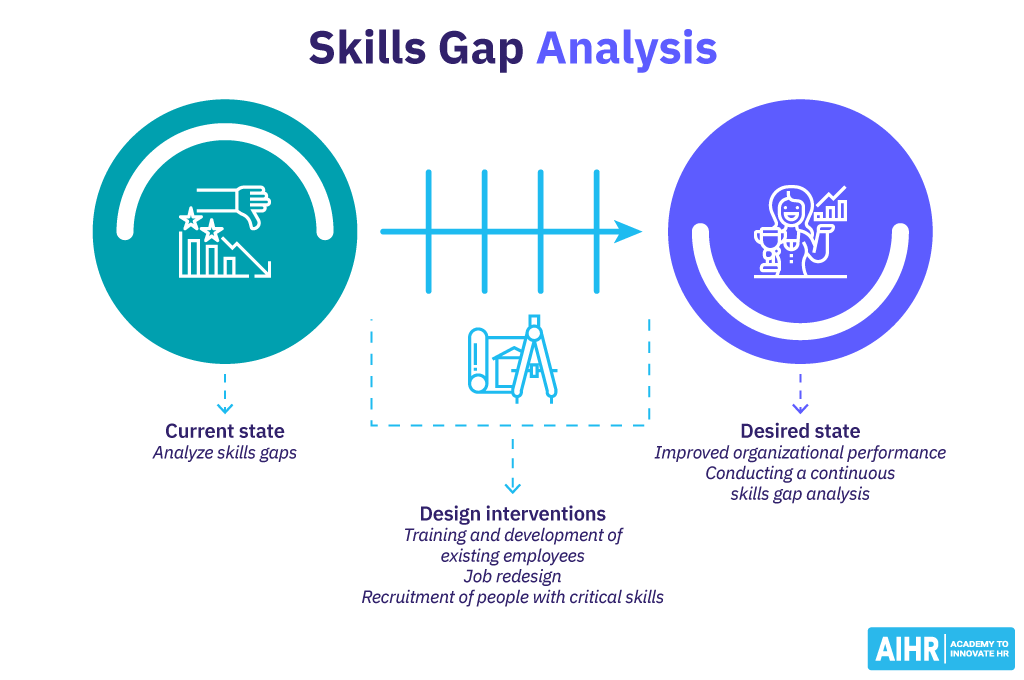
A skills gap analysis is an HR evaluation process used to measure the difference (or gap) between a workforce’s current capabilities and the skills required to achieve present or future business goals. It identifies the specific competencies employees need to perform their roles effectively (Antonucci, Ovidio, 2012).
Organizations can experience gaps in both hard and soft skills. On the technical side, employers expect AI and big data, networks and cybersecurity, and technological literacy to be the fastest-growing skills, according to the World Economic Forum. Human skills matter just as much. Employers rank analytical thinking as the most essential core skill, followed by resilience, flexibility, and agility, and leadership and social influence.
With no end in sight to the fast-paced change of technology and the evolving business landscape, organizations without adequate skill sets will struggle to keep up. When a workforce isn’t equipped to handle new responsibilities, innovation declines, employees underperform or leave, and customer expectations can’t be met.
Conducting a regular skills gap assessment allows HR, along with team leaders and possibly external consultants, to find out which specific skills and knowledge are lacking among the employees. This is typically done in preparation for upcoming changes, such as new projects, strategy shifts, and technology updates.
With this data at hand, HR can address the skills gap through upskilling, reskilling, L&D investments, succession planning, and other methods that we will discuss later in this article.
Real-world skills gap examples
Organizations that decide to tackle a skills gap issue can find ways to solve the problem. Here are four examples of how companies identified skills gaps and took targeted action to close them.
Example 1: NASA
The challenge
The U.S. government’s space research and exploration agency, the National Aeronautics and Space Administration (NASA), relies on data scientists for its operations. Since these professionals are in high demand, they looked internally at what the current workforce had to offer. Employees across the organization had data capabilities, but the wide range of talent had not all been categorized.
The solution
NASA was able to build a talent-mapping database that identifies the data skills required for various projects. It helps match employees with the right skill sets to projects requiring those competencies.
Example 2: Verizon
The challenge
Communications technology company Verizon has a goal of preparing 500,000 individuals for future roles.
The solution
It developed a tech apprenticeship program called Verizon Thrive. The 12-month earn-and-learn program trains high-potential individuals in the important skills Verizon tech roles require. After completing the apprenticeship, 95% of the first group of apprentices accepted full-time employment offers from Verizon.
Example 3: Chipotle
The challenge
Fast casual restaurant chain Chipotle faces the food service industry’s common struggles of high turnover and a lack of employees with management skills.
The solution
Chipotle offers employees a debt-free college degree program that pays 100% of tuition costs upfront. Chipotle’s employment retention rate is 3.5 times higher among crew members who are enrolled in the program. In addition, employees who take advantage of the benefit are 7.5 times more likely to be promoted to management roles.
Example 4: AI-driven healthcare startup
The challenge
Miriam Groom, CEO of Mindful Career and Leader Human Capital at KPMG, shared an example of a skills gap at an AI-driven healthcare startup. “While their engineers were adept at developing cutting-edge algorithms, there was a gap in understanding healthcare nuances and patient-centric design,” said Groom.
The solution
“This revelation led the company to initiate a cross-functional TechMed collaboration program. Engineers were paired with medical professionals for immersive experiences, leading to a fusion of tech brilliance with empathetic, patient-first solutions. Not only did their product efficacy improve, but the company also reported an uptick in employee satisfaction due to this multidisciplinary learning.”
A skills gap analysis becomes much more valuable when its findings inform targeted L&D decisions. Build the L&D expertise that will enable you to connect gaps to interventions that support current and future business needs.
With AIHR’s Learning & Development Certificate Program, you’ll learn how to:
✅ Identify current and future learning needs using practical skills gap analysis methods
✅ Translate skills gaps into targeted learning interventions and development priorities
✅ Build an L&D strategy that aligns learning with long-term organizational objectives
✅ Use learning analytics to measure the effectiveness and impact of your interventions
🚀 Head to the Demo Portal to preview lessons and understand what learning with AIHR looks like.
Why is a skills gap analysis important?
According to the World Economic Forum’s Future of Jobs Report, workers can expect 39% of their existing skill sets to be transformed or become outdated over the next five years.
For organizations across all industries, this means that certain jobs will disappear while others’ core tasks and responsibilities will change. This is where job redesign becomes relevant for rearranging these tasks and responsibilities to align them with the changing reality of work.
Before you start redesigning jobs, you need to know what skills and knowledge are currently missing in your workforce. Which of those skills are essential for your organization’s performance?
Here are key reasons why an employee skills gap analysis is worth the effort.
It gives you insights into your entire workforce
A skills gap analysis identifies which employees have the most desired skills and knowledge of particular aspects of the business, as well as the employees with significant skill gaps.
As such, you can better target employee training and development efforts on those skills that require the most attention. This will lead to the optimal use of resources to improve the overall performance of the team. This visibility is rare. Gartner found that only 8% of organizations have reliable data on the skills their workforce currently has.
It boosts individual learning and development
A skills gap analysis helps individual employees find out what improvements they’ll have to make to acquire or improve the skills and competencies needed to perform well now and in a future role. The need is widespread. The World Economic Forum estimates that if the global workforce were 100 people, 59 would need training in the coming years.
It will also highlight which employees are making the strongest contribution and deserve raises or promotions. This can also have a positive impact on your employees’ productivity.
It helps your strategic workforce planning
Strategic workforce planning is, among other things, about making sure you’ve got the right number of people with the right skills in the right place. It’s difficult to start planning for the future if you don’t know exactly where you currently stand from a skills perspective. In a Gartner survey, 62% of HR leaders said uncertainty around future skills poses a significant risk to their organization.
A skills gap analysis shows you which key positions lack core competencies. From there, you can set goals and define benchmarks for getting the workforce where it needs to be.
It can improve your recruitment and talent acquisition efforts
You have to know what you are looking for in order to find it. It’s much easier to recruit strong candidates if you can identify the ones whose skills best match those needed to function effectively in a particular role.
You can also develop new talent acquisition strategies that will target and attract the types of people you need.
It creates a competitive advantage
If you combine all of the above, you’ll be able to create a competitive advantage and stay ahead of your competition. You’ll know the strengths and weaknesses of your workforce. That way, you can better plan for learning and development and recruitment to optimize your organization’s performance.
“Skills gap analysis in the modern age isn’t just about identifying missing competencies but also about creating an organizational culture of continuous learning, adaptation, and collaboration.”
Miriam Groom, CEO of Mindful Career and Leader Human Capital at KPMG
How to conduct a skills gap analysis in 3 steps
These three steps are loosely based on the organizational development process. Use them to move from a list of required skills to a clear plan for closing gaps.
Step 1: Define the scope and the skills you need
Start by deciding what level you’re analyzing. You can conduct a skills gap analysis for:
- An individual, when the duties of a position are changing, or an employee is falling below performance standards
- A team, when a project requires employees to complete new tasks or use new technology
- The whole organization, when the company isn’t achieving its business goals, or a strategy shift requires new capabilities.
Next, list the skills that the level needs, now and in the future. These questions help.
- What are the organization’s mission and business goals?
- Which hard and soft skills do we value as an organization?
- What critical skills do we need to meet our goals?
- Which jobs are likely to be affected by AI and automation?
- What skills are on the rise in our industry, and which roles will we need to add or expand?
Focus on critical skills. If an employee lacks a skill but still completes a task satisfactorily, the skill is non-critical. If the missing skill leads to an unsatisfactory outcome, it’s critical.
Step 2: Measure current skills and identify gaps
Now compare what you need with what you have. Start by building a profile for each role. Review current position descriptions, consider upcoming regulatory changes and work trends, and list the competencies that best describe what the job requires.
Then take an inventory of your employees’ current skills. Useful sources include
- Performance evaluations and competency assessments
- Employee self-assessments and 360-degree feedback
- Skills tests or work samples for technical skills
- Interviews or focus groups with employees, supervisors, and managers
To calculate each gap, compare the required proficiency level with the employee’s current level. Use the same rating scale everywhere, such as 1 (no knowledge) to 5 (expert), and describe each level in plain terms so different raters score consistently. If a role requires a 4 in data analysis and the employee rates a 2, the gap is 2 points. Averaging scores across a team shows where the largest shared gaps sit, and a skills matrix makes these patterns easy to spot.
Store all of this in one searchable place. A talent management system can pull together performance and competency data, and many platforms now use AI to infer skills from job histories and learning activity. Treat AI-generated profiles as a starting point and have managers validate them before you act on them.
Step 3: Prioritize gaps and design interventions
Your analysis will likely surface more gaps than you can close at once, so prioritize. Gartner research found that focusing on the core skills employees need today has five times greater impact on sustained performance than focusing on the skills of tomorrow. Start with gaps that hurt current performance in business-critical roles, then plan for future needs.
High impact, needed now
Sales team can’t use the new CRM
Close it immediately with targeted training or a hire
High impact, needed later
AI skills for a product launch next year
Start upskilling or plan hiring now
Low impact, needed now
Minor gaps in internal reporting tools
Use coaching, job aids, or peer support
Low impact, needed later
Nice-to-have skills for future projects
Monitor and revisit in your next review
“Oftentimes there are gaps in areas that seem important to address, but if this doesn’t align with organizational needs, it may not be an appropriate use of resources and may not get appropriate support.
Also, once the analysis is done and a solution is created, failing to get buy-in from the senior leadership is a sure way to not get the resources and support needed.”
Chris Wong, Executive Coach and Consultant at Leadership Potential
Once you know your priorities, choose how to close each gap. There are four main options.
- Train existing employees. Use the gaps to define your training needs and build targeted training that equips employees with the missing skills.
- Redesign jobs. If your goals now require different work, job redesign rearranges tasks and responsibilities, often combined with upskilling and reskilling.
- Move talent internally. The skills you need may already exist elsewhere in your organization. Internal mobility closes gaps faster than hiring and boosts retention. Yet Gartner found that fewer than 20% of organizations do this effectively.
- Hire for critical skills. New hires with the right skills become productive sooner. If you can’t hire fast enough, freelancers or contractors can fill a gap temporarily.
Most organizations combine these. According to the World Economic Forum’s Future of Jobs Report, 85% of employers plan to upskill their workforce, 70% expect to hire staff with new skills, and 50% plan to move staff from declining roles into growing ones.
Avoid these common pitfalls
Kinga Golebiowska, People & Culture Partner at HR Hints, warns of three challenges HR professionals often face.
- Being surrounded by technology that often forces us to change how we work, allowing us to benefit from automation, we might tend to focus solely on technical skills when performing skills gap analysis. This way, we may overlook critical inter- and intrapersonal skills like communication, adaptability, and leadership, which are often essential for success.
- Failing to consider future industry trends and advancements can result in a short-term solution that becomes obsolete quickly.
- Employees may resist changes if they are not adequately prepared or involved in the process. Effective change management is essential to addressing this challenge.
Once you’ve finished, keep your analysis up to date. A skills gap analysis isn’t a one-off exercise. “A general guideline is to conduct a comprehensive review every 12-24 months. However, in fast-evolving industries, it might be necessary to assess skills gaps more frequently,” notes Golebiowska. Regular reviews help you spot gaps before they hurt performance.
Skills gap analysis examples
It’s important to have a standardized format for conducting a skills gap analysis. A well-structured process will produce the correct and most helpful information. Below are two practical approaches, one simple and one quantitative.
Simple individual skills gap analysis example
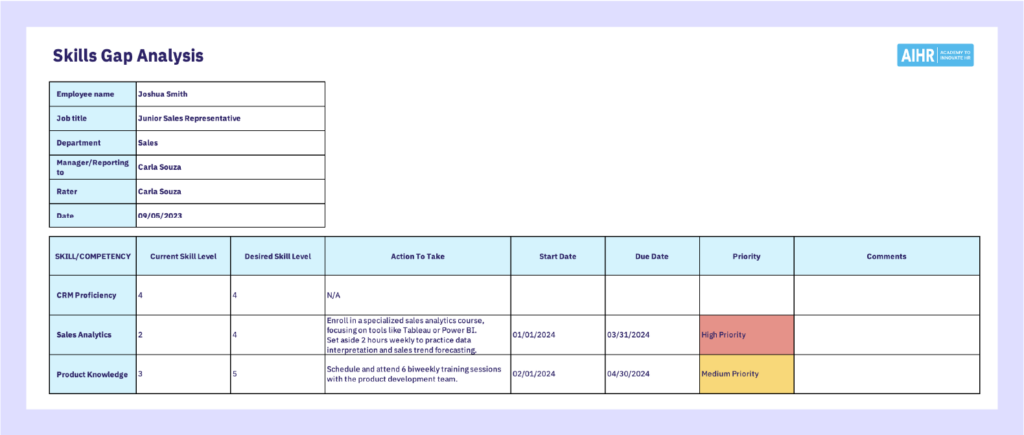
A simple skills gap analysis uses a spreadsheet that compares an employee’s current skill levels with the levels their role requires. It would contain the following fields:
- Employee name and job title
- Skill to measure (these should be as specific as possible and relevant to a position, either currently or in the future)
- Skill level rating (point system)
- Desired skill level (point system)
Be sure that everyone who is assessing employees’ skill levels has consistent criteria and understands how to apply them to their ratings.
You can customize a simple skills gap analysis spreadsheet for different teams or purposes, such as by department or for soft skills or hard skills.
Here’s an example of an individual skills gap analysis for a junior sales representative.
Quantitative skills gap analysis example
Antonucci and Ovidio proposed a quantitative approach to skills gap analysis, which measures the gap of each competency for every examined subject.
The algorithm they designed only takes into account the negative gap situation of an employee’s competencies being lower than the ones needed. They’re also distinguishing between a skill gap of often-used competencies and a gap of competencies that are rarely used.
The starting point of this analysis is mapping the skills needed for each working profile. The benchmark for each required competence can be determined either with a top-down (from managers to employees) or a bottom-up (from employees to managers) process.
The advantages of benchmarking this way are:
- The procedure doesn’t change if the top-down or bottom-up approach is used.
- You get quantitative estimations of the skills gap, taking into account the importance and frequency of use.
- It enables a flexible, semiautomatic process for planning training courses.
This results in the following skill gap indicator:
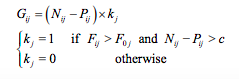
In this formula, the indicator G of the gap in the j-th skill is calculated. The other variables in the formula stand for:
- N – indicates the score of necessity assigned to the i-th interviewee for the j-th skill
- P – indicates the score attributed to the level of the skill possessed by the employee.
- F indicates the frequency of the use of the skill by the same employee.
- c – is a constant to cut the effect of low or negative gaps (i.e., zero or one)
- F indicates the frequency of the use that, in the ideal benchmark of the company, represents the threshold above which the skills shortage represents a problem that is to be solved (while taking into account the costs of training).
- K permits to take into account only positive gaps (when a certain, relatively frequently used skill isn’t sufficiently possessed).
Key factors for quantitative skills gap assessments
- Data collection: Businesses can collect the relevant data using paper-based assessments and supporting interviews or through skill management software. Especially when you’re conducting a skill gap analysis among a large number of employees, the latter becomes the more obvious option.
- Types of assessments to obtain the required information: Self-assessment surveys or 360-degree assessments can gather the necessary skills, the frequency of use of certain skills, and the store of skills specific to each role. Feedback tools such as 15Five collect and analyze feedback from and about your employees.
- Scoring: The skill assessments are expressed on a scale of 1 to 5, with 1 being the lowest and 5 being the highest level. For each level, every interviewee gives a score to the level of skills actually possessed and the skill level they consider necessary. The same scoring method is used to indicate how intensely a skill is being used in the company.
Once you’ve gathered all the relevant data, you’ll be able to examine the deviations between the level of skills possessed and necessary by individual employees, as well as the frequency with which they are used in the company. This will then allow you to take action, resulting in one or more of the skills gap interventions we described above.
Free skills gap analysis templates
General skills gap analysis template (team level)
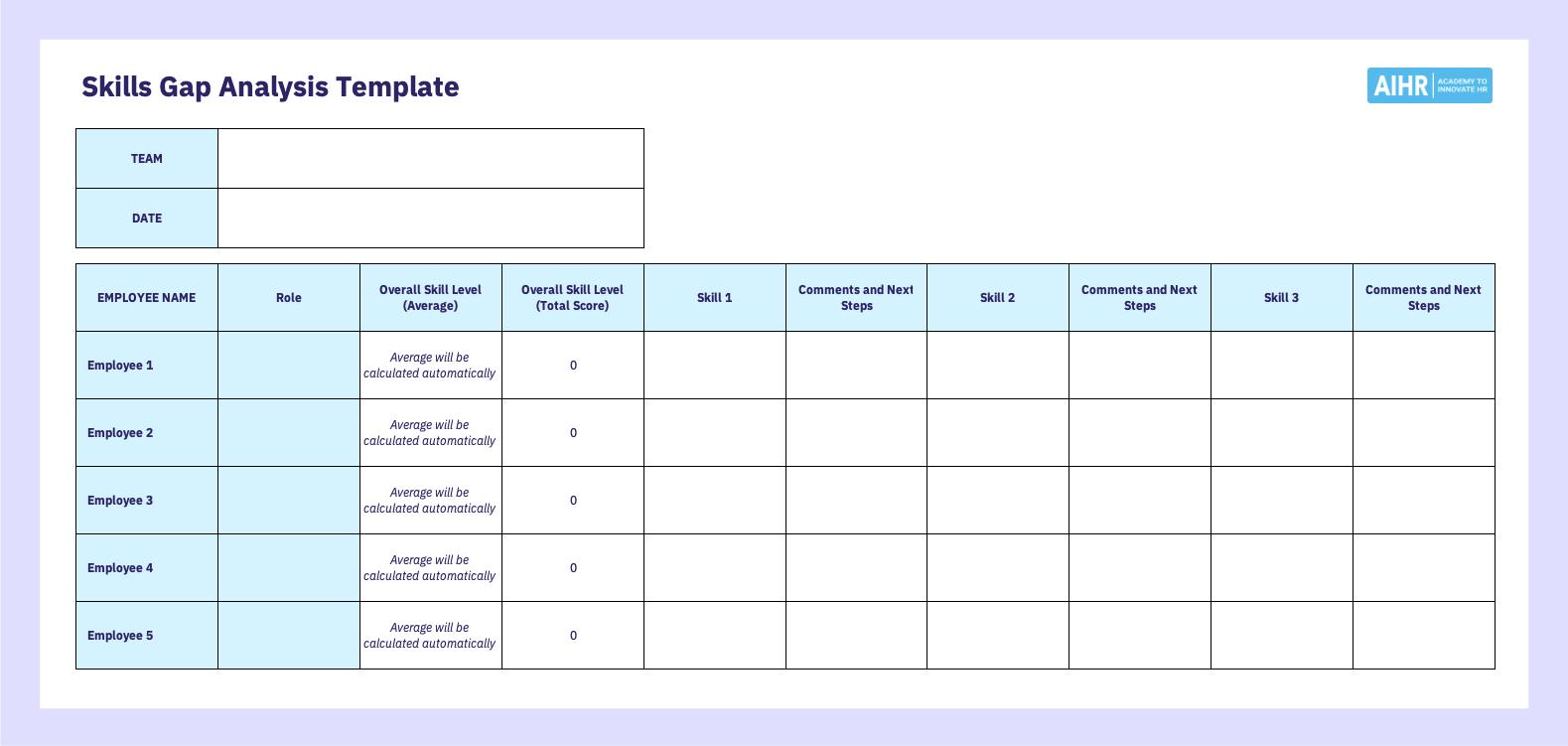
Using a skills gap analysis template helps you consistently and systematically identify and address discrepancies between current employee competencies and those required for optimal performance.
The template provides a structured framework, making it easier for organizations to assess skill deficiencies and prioritize areas for development on a team and individual level. You can also use it as a competency gap analysis or training gap analysis template by swapping in competencies or training requirements instead of skills.
Below is the team skills gap analysis template:
AI skills gap analysis template
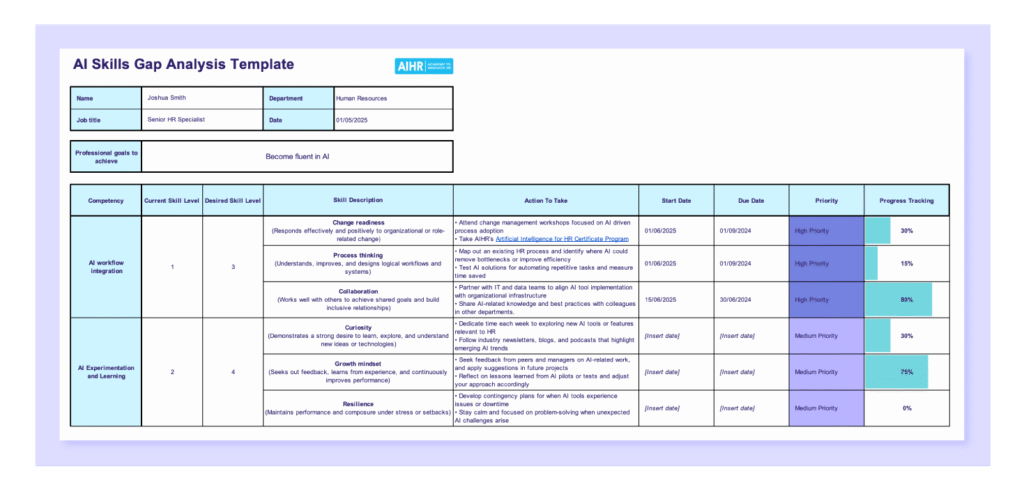
The AI skills gap analysis template helps you spot where your workforce stands today with AI capabilities and what skills are needed for the future. Use it to identify gaps in areas like machine learning, prompt engineering, or AI ethics, and create a clear plan to close them.
Skills gap analysis tools and software
A skills gap analysis tool is any template, system, or platform that compares employees’ current skills with the skills their roles require. For a single team or a first analysis, a simple spreadsheet is often enough. Once you track skills across many roles or repeat the analysis regularly, dedicated software keeps your data current and saves time.
The main types of software, with examples, are:
- Skills management platforms, such as AG5 and Skills Base, which build a skills inventory and show gaps in a visual matrix
- Skills assessment tools, such as iMocha, which test proficiency instead of relying on self-ratings
- Talent and learning suites, such as Cornerstone, which connect gaps to performance data and training
- AI skills intelligence platforms, such as 365Talents, which infer skills from employee data and support internal mobility.
The best tool depends on the decision it needs to support. Check that it integrates with your HRIS and learning systems, and that managers can review AI-generated skill profiles before you act on them.
Next steps
A skills gap analysis shows you what your workforce can do today and what it needs to succeed tomorrow. The real value comes from what you do with the findings.
To turn gaps into targeted learning, build your L&D expertise with AIHR’s Learning & Development Certificate Program. You’ll learn how to identify learning needs with practical skills gap analysis methods, translate gaps into development priorities, and measure the impact of your interventions.
FAQ
A skills gap analysis is an HR tool used to assess the difference (or gap) between the current state of employees’ competencies and what is necessary to achieve business goals. For HR, the skills gap analysis is a way to find out which skills and knowledge are lacking among the employees in the organization.
A skills gap analysis gives you insights into the skills of your entire workforce, boosts individual learning and development, helps with strategic workforce planning, improves recruitment efforts, and creates a competitive advantage.
Put simply, you start by identifying the needed skills based on the organization’s mission and business objectives. Then you collect data and analyze your employees’ current knowledge and skills. Finally, you prioritize and close the skills gaps you’ve detected through training, job redesign, internal mobility, or hiring.
A sales representative whose role requires advanced CRM skills, rated 4 out of 5, but who currently rates a 2 has a 2-point skills gap in CRM proficiency. At a team level, a gap might be a data team where only one person can build predictive models when the next project needs three.
A skills gap analysis identifies which skills are missing. A training needs analysis takes those gaps and determines which ones training can close and what type of training to provide. A competency gap analysis works like a skills gap analysis but measures broader competencies, such as behaviors and knowledge, against a competency framework.
A skills matrix is a grid that maps employees against the skills a team needs and their proficiency in each. A skills gap analysis uses that data to measure the difference between current and required levels and decide how to close it.