

AI dominates much of the current discussion about the future of work. But the pressures facing organizations today did not begin with AI. Geopolitical instability, demographic change, skills shortages, shifting employee expectations, and tighter regulation were already reshaping the workforce.
AI has added urgency to these challenges and, in many instances, compounded their impact. It has accelerated the pace of change, exposed weaknesses in existing operating models, and made it harder for organizations to rely on familiar workforce assumptions.
These forces are also closely connected and tightly integrated. The challenge for HR is not simply to respond to each one individually, but to understand how they interact and what they mean for the organization as a whole, as it sets an agenda for the future.
In this article, we explore the six forces reshaping the workforce, how they relate to the required HR response, and the changes that will shape HR’s future role.
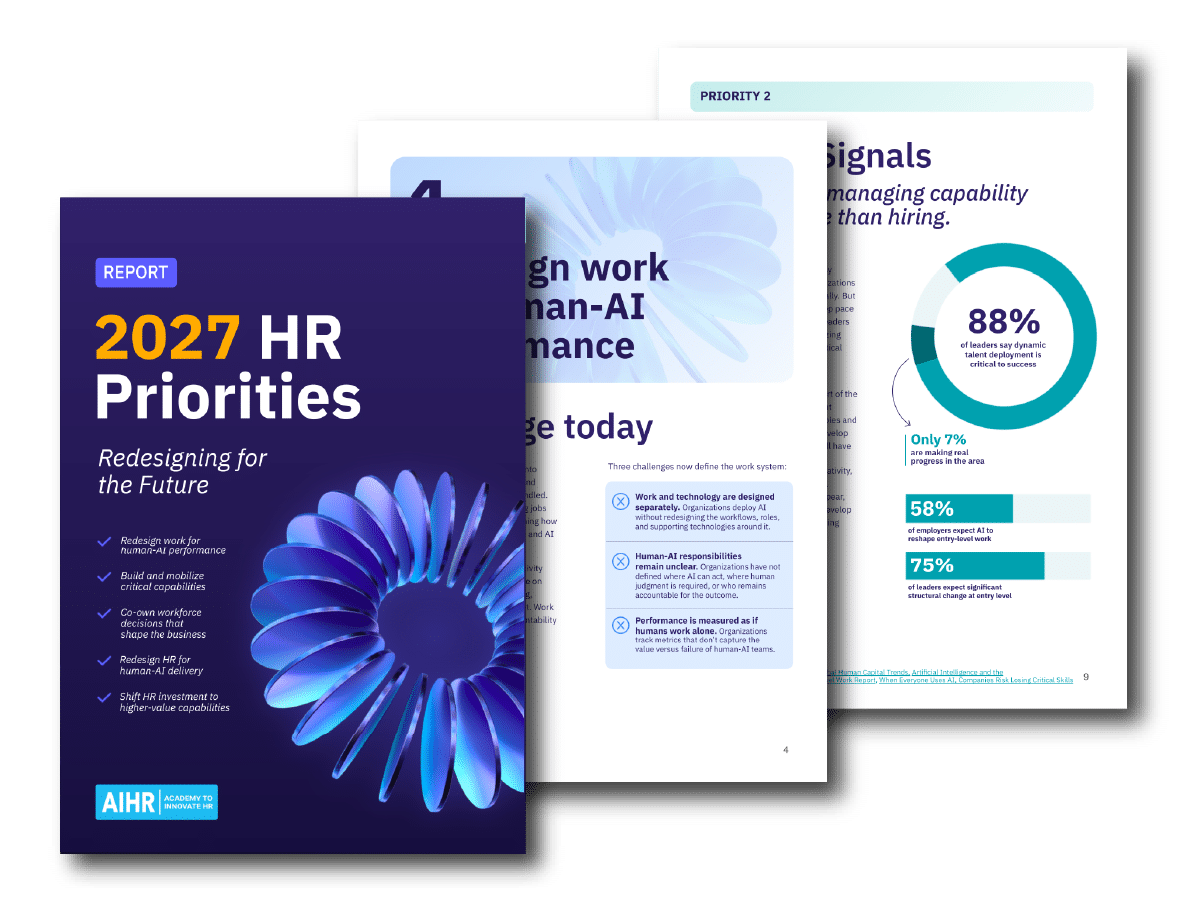
The trends show where work and HR are changing. HR Priorities 2027: Redesigning for the Future report focuses on what HR leaders can do next, with practical priorities for building the capabilities, operating model, and workforce your organization will need.
6 forces reshaping the workforce
Force 1: Geopolitical and economic instability
Conflict, together with geopolitical instability, has reached levels not seen in decades. The Peace Research Institute Oslo recorded 61 active state-based conflicts in 2024. This is the highest number since records began in 1946. The consequences are increasingly visible in the business environment, as organizations contend with disrupted supply chains, rising costs, and greater uncertainty about where and how they operate.
For HR, the implication is to build a more resilient organization that can make decisions amid uncertainty and help leaders navigate the messy middle. None of this is new, but the scale of uncertainty now makes these links more consequential.

Force 2: Demographic and labor supply constraints
Labor availability can no longer be taken for granted. The EU’s working-age population is expected to decline by 41.9 million between 2025 and 2050. The dependency ratio is projected to fall from 1.7 working-age adults per dependent today to 1.3 by 2065.
Fertility rates are declining across the major trading blocs, with no modeled recovery before 2100. Migration, which has historically helped offset domestic labor shortages, is also falling in many regions, partly due to the geopolitical tensions and anti-immigration policies prevalent in many developed countries today.
These are not distant or abstract risks. Much of the workforce available ten or twenty years from now has already been determined. Employers will increasingly have to compete for a smaller pool of workers.
HR will need new talent strategies that balance the perspectives of talent demand and supply. This will call for inclusive strategies that emphasize prioritizing non-traditional talent pools. It also requires broader access to underrepresented talent pools, job redesign, and more deliberate decisions about automation and location.
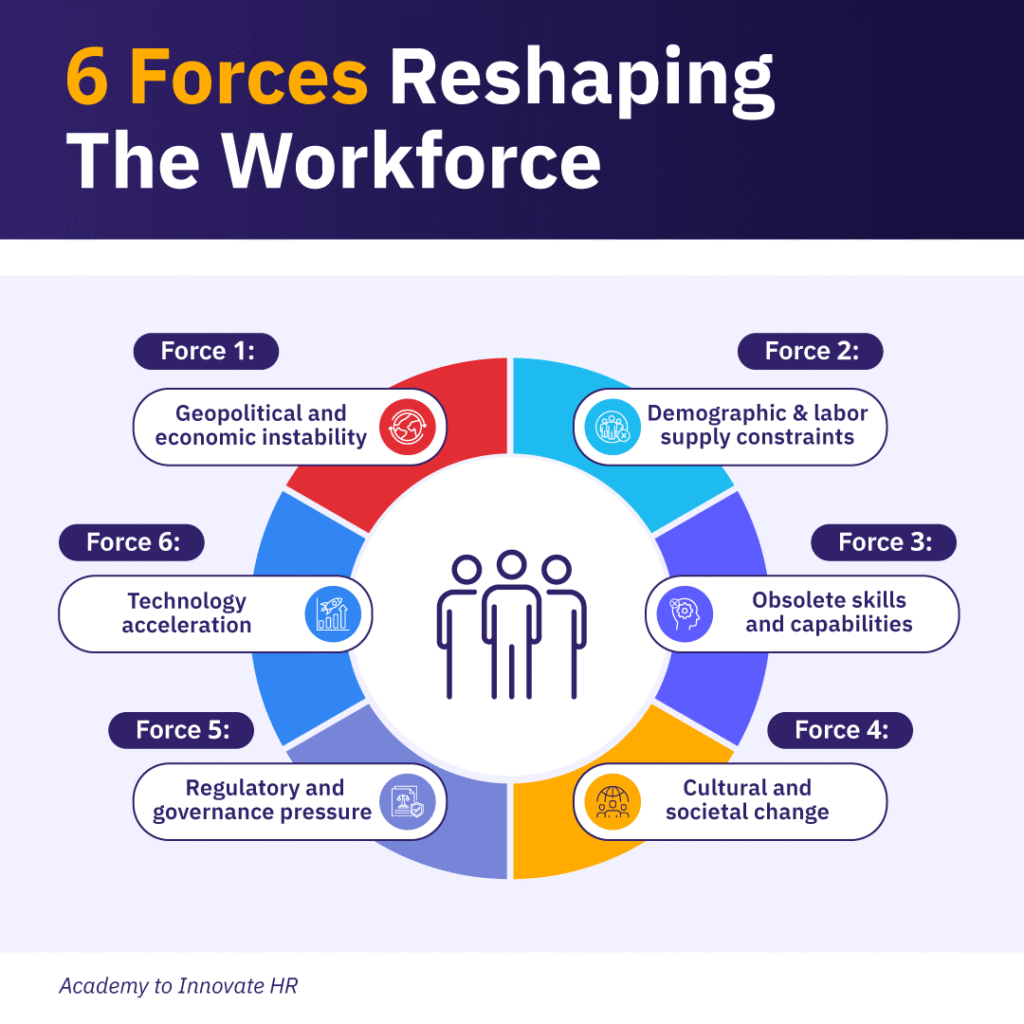
Force 3: Obsolete skills and capabilities
The availability of people is only part of the problem. The skills organizations need are also changing quickly.
Labor scarcity and skills disruption should not be treated as separate issues. They are linked, as organizations face both a declining supply of workers and a widening gap between the capabilities they have and those they need.
HR should identify the capabilities the strategy will require, assess current skills gaps, and create clearer pathways for upskilling, reskilling, redeployment, and internal mobility. Again, this is nothing new; however, failing to do so, alongside the labor shortage, will significantly affect organizations’ ability to execute effectively.
Force 4: Cultural and societal change
Employees’ expectations of work have also shifted. Flexibility remains important, but the change goes beyond where and when people work. Employees increasingly expect greater autonomy, inclusion, purpose, and support for their wellbeing.
The pandemic accelerated some of these expectations, while generational and societal change have helped sustain them. At the same time, trust in institutions, including employers, remains fragile.
Organizations may disagree with or resist these changes, but they cannot simply dismiss them. When expectations are poorly understood or badly managed, the effects tend to appear in engagement, performance, and retention.
HR needs to be clear about the balance among the employer brand, the employee value proposition, and the employee experience. It must understand the expectations of different workforce groups and strengthen trust, while equipping managers with the tools to balance flexibility, autonomy, inclusion, well-being, and performance. These elements need to be integrated into the organizational DNA and the employee experience.
Force 5: Regulatory and governance pressure
Regulation is becoming a more significant part of workforce strategy. In Europe, the Pay Transparency Directive came into effect in June 2026, with substantial penalties possible for non-compliance. Provisions governing high-risk uses of AI are also coming into force under the EU AI Act, while the Platform Work Directive will increase employers’ exposure to the risk of worker misclassification.
Similar developments are taking place in the United States. Colorado’s AI Act introduces a duty of “reasonable care” when high-risk AI systems are used in decisions relating to hiring, promotion, and pay. California, Illinois, and New Jersey are moving in a similar direction.
Employment-related AI remains a significant area of regulatory exposure. Under the EU AI Act, systems used for recruitment, selection, promotion, termination, task allocation, and performance monitoring may qualify as high-risk systems. Following the 2026 AI Omnibus, the principal requirements for these systems are scheduled to apply from December 2027.
HR should work with legal, risk, technology, and finance to review pay structures, employment models, workforce data, and decision-making procedures before new rules take effect, and to educate the workforce on pay principles and update internal governance.
Force 6: Technological acceleration
AI differs from many earlier workplace technologies in that it can perform elements of cognitive work at scale. It can read, analyze, write, summarize, recommend, and, in some settings, support or make decisions.
Its adoption is outpacing many organizations’ governance structures, operating models, and workforce capabilities. Yet the financial results remain uneven. 12% of CEOs report improvements in both costs and revenue from AI, while 56% report no financial benefit at all.
There is a credible productivity opportunity, but the evidence for sustained value is still developing. Organizations need to distinguish between experimentation, isolated efficiency gains, and measurable improvements in business performance, and understand how these stages connect.
Where the forces reshaping HR intersect
The relationship between these forces is evident in the labor market data.
For example, healthcare and hospitality face some of the most severe worker shortages, yet they also report the lowest rates of AI adoption: 0.7% and 0.4%, respectively.
The sectors with the greatest need to redesign work may also have the least capacity to adopt new technology. Automation will not automatically resolve their labor shortages. In some cases, the shortage itself may make transformation harder by leaving organizations without the time, skills, or investment capacity to implement it.
There is a similar tension in current workforce-reduction plans. Despite widespread concern about AI-related job displacement, 82% of CEOs and board directors expect AI to replace less than 20% of their workforce over the next three years. At the same time, only 8% are confident that their AI investments will deliver a meaningful return during that period.
Gartner found that approximately 80% of organizations piloting or deploying autonomous-business technologies had reduced their workforces. Yet workforce-reduction rates were almost the same among organizations reporting strong returns and those reporting modest or negative outcomes. Cutting headcount may create budget room, Gartner concluded, but it does not, in itself, create a return on AI.
This suggests that some reductions presented as AI transformation are still conventional cost-cutting decisions. That does not necessarily make them unjustified, but it does mean organizations should be honest about their rationale and careful about the longer-term consequences of linking AI claims to headcount cuts.
Reducing headcount today without changing the work, the operating model, or the underlying demand may create a recruitment problem later. In a tightening labor market, rebuilding lost capacity may prove slower and more expensive than expected.
A different question for HR
For many years, HR has been asked to demonstrate how it adds value to the business. That framing increasingly feels too narrow. It positions HR as a supporting or partnering function operating around decisions made elsewhere.
A more useful question is whether the organization can execute its strategy with its current workforce system, and whether HR’s mandate can make this a reality.
Can it secure the people and skills it needs? Can it redesign work as technology develops? Can it respond to regulatory change? Can it maintain critical capabilities while controlling costs? Moreover, can it do all of this in a labor market where supply is becoming less predictable?
This does not mean that HR simply needs to do more. It calls for three important shifts to reposition HR mandate and scope for the future.
First, HR needs a clearer view of the organization’s current workforce and the strategic choices ahead. That requires more than workforce reporting. It means understanding where critical capabilities sit, where supply risks are emerging, and how different business scenarios would affect workforce demand.
Second, HR operating models need to support action across traditional functional boundaries. Workforce design draws on strategy, finance, technology, operations, risk, and HR. It cannot be managed effectively through separate processes that meet only at the point of implementation.
Third, HR teams need to develop the capabilities required for this work. These include workforce planning, data literacy, organizational design, technology governance, and regulatory foresight. Transactional expertise will remain necessary, but not sufficient.
Final thoughts
AI did not create the conditions facing CHROs today. It entered a system already under pressure from labor scarcity, geopolitical instability, regulatory change, skills disruption, and changing expectations of work.
What AI has done is increase the speed and visibility of these pressures. It has also made it easier for organizations to describe conventional restructuring as technological transformation, even where the evidence of AI-driven productivity remains limited.
Treating the present moment primarily as a technology challenge risks producing a technology-led response to what is fundamentally an organizational problem. The more important task is to reconsider how work is designed, how workforce capacity is built, and how HR contributes to strategic decisions.
These forces will continue to develop regardless of how quickly HR responds. The question is whether HR helps shape the organization’s response or is left managing the consequences.